The Arctic never sleeps
The polar night: an ocean that is far from asleep
When the Sun disappears below the horizon for several months, the Arctic seems to fall into a deep sleep. The polar night wraps the landscapes in almost constant darkness, temperatures plummet, ice covers the fjords and silence seems to reign over these vast frozen expanses.
For a long time, scientists believed that marine life followed the same rhythm. Without light, and therefore without photosynthesis, ecosystems were assumed to slow down dramatically, or even enter a kind of dormancy until the Sun returned.
But this idea, widely accepted for decades, turned out to be wrong.
A study led by researchers at the University Centre in Svalbard and published in the journal Current Biology has profoundly changed our view of the polar night. Far from being a period of inactivity, it reveals a surprisingly dynamic ocean, where many species keep feeding, growing… and even reproducing.
A preconceived idea that was never really tested
Why did scientists think the Arctic “went to sleep” in winter?
Quite simply because most research had always been carried out in the summer months, when the days are long and working conditions are far more favorable.
As biologist Jørgen Berge, the study’s lead author, explained:
“Almost all of our research had been done during the light period of the year. We thought that in the dark there was no more primary production, and therefore practically no more activity.”
In other words, for lack of winter observations, this hypothesis had become a scientific dogma.
An earlier Canadian study had already hinted that surface waters remained more active than anyone imagined. The Norwegian team went much further, exploring all the marine ecosystems of an Arctic fjord during the darkest period of the year.
Three winters exploring the polar night
Between January 2013 and January 2015, nearly a hundred researchers crisscrossed Kongsfjorden, a fjord on the west coast of Spitsbergen.
Their goal was ambitious: to observe what happens during the 117 days when the polar night is at its deepest.
Using trawls, cameras and a wide range of scientific instruments, they sampled the water column as well as the seafloor down to 200 meters deep.
The results surprised the entire scientific community.
Far from finding a biological desert, the researchers discovered an ecosystem in full swing.
A food chain that keeps on working
The first surprise came from microscopic organisms.
In the surface layers of the ocean, the scientists found diatoms and dinoflagellates, two groups of microalgae that form the base of the marine food chain.
Despite the lack of sunlight, these organisms still contained significant amounts of chlorophyll and pigments.
Zooplankton, which feed partly on these microorganisms, were also abundant at every depth studied.
In other words, the very foundation of the marine ecosystem was still working when everyone thought it had all but shut down.
Reproduction even continues through the winter
One of the most astonishing discoveries concerns copepods, tiny crustaceans that are an essential food source for many species of fish, birds and marine mammals.
The researchers observed large numbers of males of the genus Calanus, which are practically absent in summer, along with females already carrying spermatophores, proof that reproduction was under way.
These observations show that the polar night is a key period in the life cycle of many species.
Rather than waiting for the Sun to return, they use this season to reproduce and prepare the next generations.
The seafloor stays very active too
Life is not confined to the water column.
On the floor of the fjord, the scientists found that the communities living in the sediment were just as abundant as in the fall.
Among them is the Iceland scallop (Chlamys islandica), which keeps on growing even though the water is 3 to 5°C colder than in summer.
With no fresh phytoplankton available, these shellfish appear to feed mainly on suspended organic matter, demonstrating a remarkable ability to adapt to long periods of scarcity.
Not all seabirds abandon the Arctic
Contrary to a widespread belief, not all seabirds migrate south before winter.
In Kongsfjorden, the researchers watched black guillemots, little auks, northern fulmars and glaucous gulls still out hunting.
Their main ally is… Arctic krill.
Some species of krill naturally produce bioluminescence, faint emissions of light that allow the birds to spot their prey despite the near-constant darkness.
So even without the sun, the food chain remains fully functional.
A new view of the polar night
This study has profoundly changed the way scientists see Arctic ecosystems.
The polar night is no longer considered a mere waiting period between two summers.
On the contrary, it now appears to be an essential season, during which species continue to feed, grow, reproduce and prepare for the return of the light.
Researchers now believe that many organisms have developed extremely effective strategies to survive and stay active through several months of darkness.
A world still largely unknown
The Arctic keeps on revealing surprises.
Just when we thought we understood how polar oceans work, this study shows that much of their life unfolds precisely during the least studied period of the year.
Each new expedition reminds us that the polar regions still hold many mysteries. Behind the apparent stillness of the Arctic night lies a teeming world, where life never really stops.
And that may be one of the finest lessons the Arctic has to offer: even in the deepest darkness, nature always finds a way to keep on thriving.Sail to Spitsbergen
aboard Polarfront
Twelve guests, a seasoned crew and passionate guides: the upcoming departures.
10 days / 9 nights Spitsbergen · WildlifePolar spring in Spitsbergen 12 of 12 spots from€12,490 25Apr2027 returning May 4 Spring
10 days / 9 nights Spitsbergen · WildlifePolar spring in Spitsbergen 5 of 12 spots from€12,490 4Aug2027 returning Aug 13 Summer
10 days / 9 nights Spitsbergen · WildlifeMidnight sun in Svalbard 11 of 12 spots from€12,620 19Sep2027 returning Sep 26 Fall
8 days / 7 nights Spitsbergen · Northern lightsAutumn escape to Svalbard 12 of 12 spots from€9,720 26Sep2027 returning Oct 4 Fall
9 days / 8 nights Spitsbergen · Northern lightsAutumn lights in Svalbard 10 of 12 spots from€11,110 4Oct2027 returning Oct 12 Fall
9 days / 8 nights Spitsbergen · Northern lightsAutumn lights in Svalbard 12 of 12 spots from€11,110
No upcoming departures for this selection.
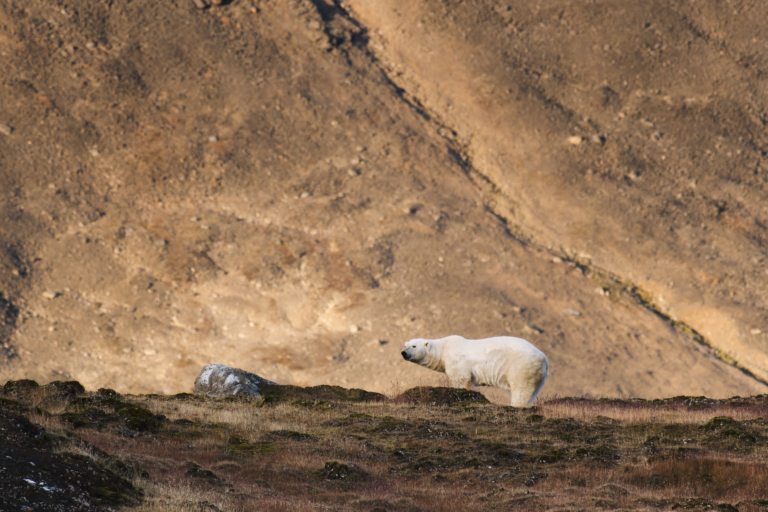
Polar bears in Spitsbergen: where and when to see them
Seeing a polar bear in the wild is the dream of many travelers heading to Spitsbergen. The archipelago is one of the best places in the world to…
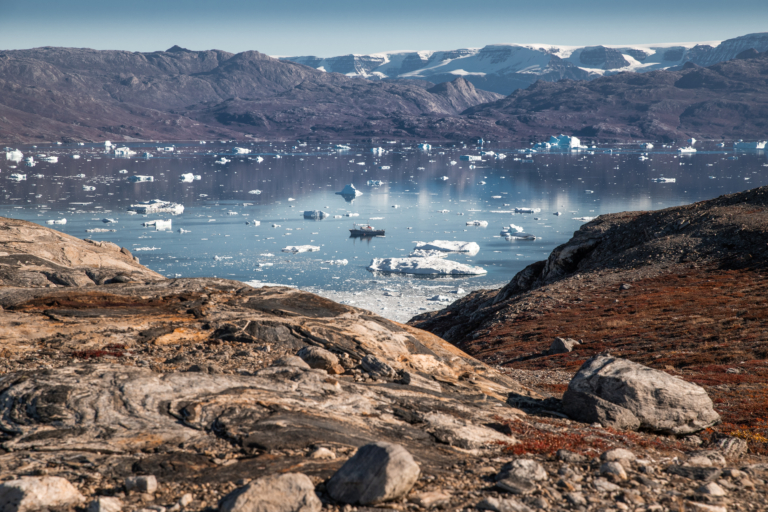
10 sounds of the Arctic you will never forget
Traveling in the polar regions means learning to slow down and pay attention to details we often overlook in everyday life. In these places, where the absence of…
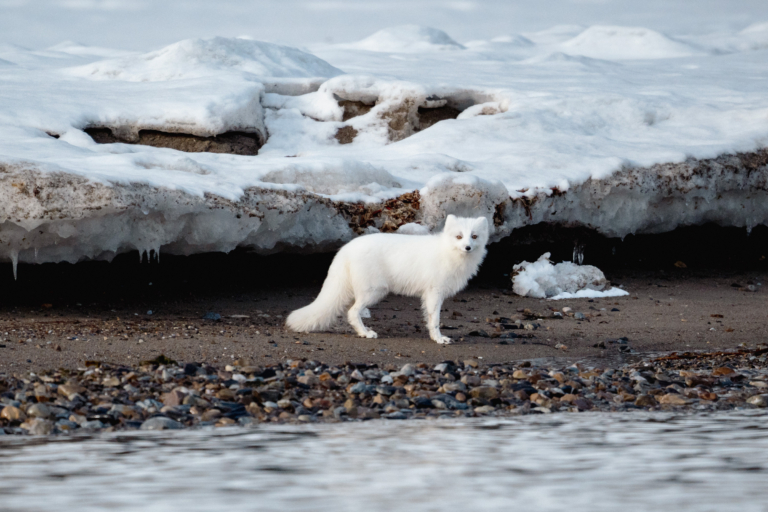
Arctic fox: how does it survive in one of the most hostile environments on the planet?
In the white vastness of the Arctic, a discreet silhouette sometimes crosses the snow-covered tundra. Fast, agile and perfectly camouflaged, the Arctic fox (Vulpes lagopus) is one of…