400 years ago, a French scientist described the northern lights
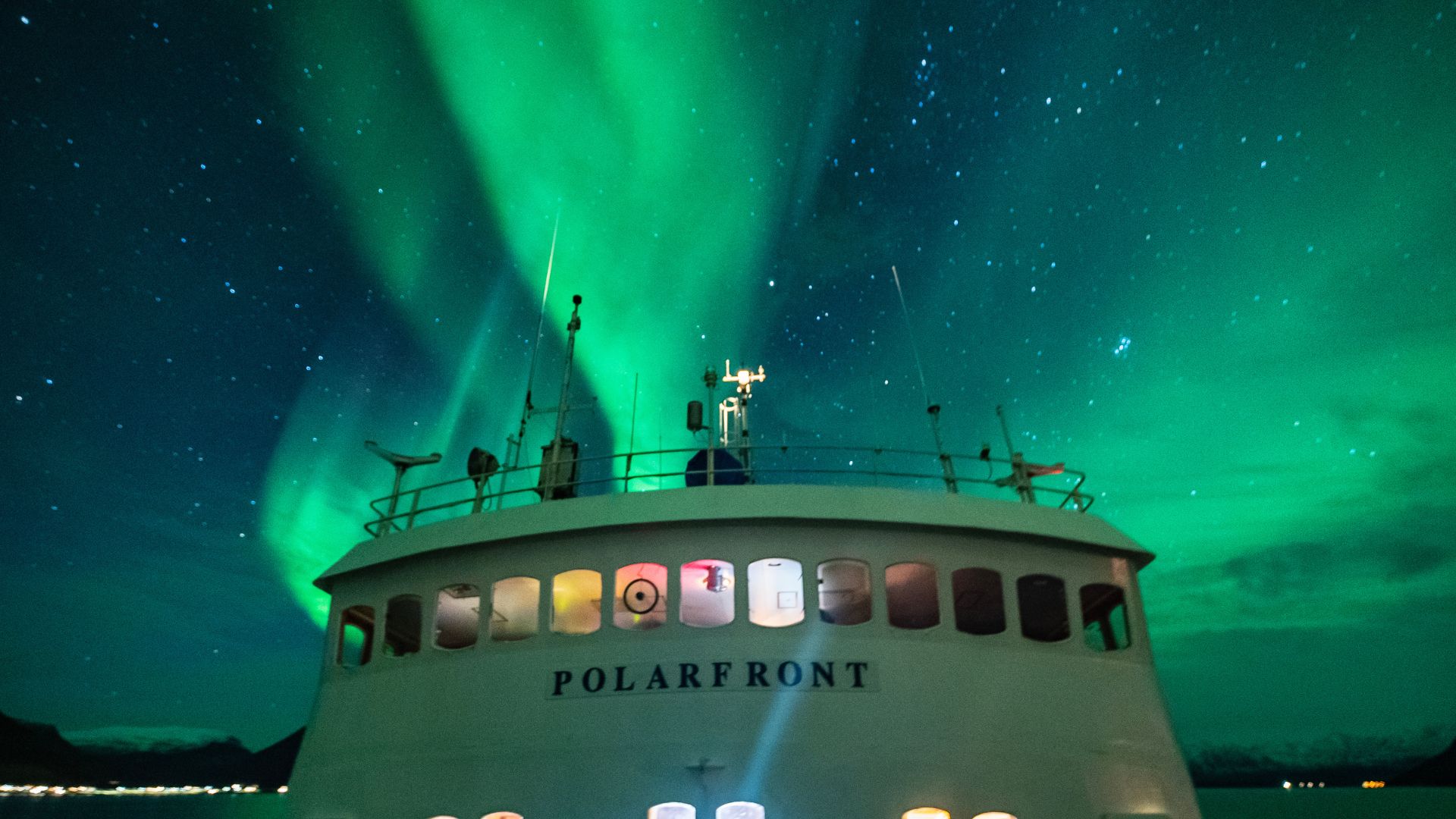
Borealis in the north, australis in the south: everywhere, auroras fascinate young and old alike. According to the European Space Agency (ESA), “the night is adorned with these fabulous colored veils when charged particles, ejected by the Sun and carried by the solar wind, rush along the Earth’s magnetic field lines and collide with atoms in the upper atmosphere.” The nature of those atoms then determines the color of the auroras.
Although polar auroras are mostly seen in northern Canada and Scandinavia, they sometimes appear farther from the poles too, during magnetic storms linked to variations in solar activity, and solar flares in particular.
It is hard to believe that such an enchanting spectacle is governed by nothing but the laws of nature. The Inuit, the Vikings and the Finns gave it a supernatural explanation: a Finnish legend, for example, says that polar auroras are created by foxes sweeping their tails and throwing up snow, and in Finnish, the word for auroras is “revontulet,” which literally means “fox fire.” Scientific interest in them took a long time to develop: although they had been described by Aristotle and Seneca in antiquity, polar auroras had a bad reputation in medieval Europe because, like earthquakes or comets, they were seen as bad omens. It was not until the 17th century that scientists began to look into the question.
On the night of September 12 to 13, 1621, Pierre Gassendi, a French astronomer, philosopher and theologian, witnessed a display of the northern lights: “There was a remarkable brightness which, on the night of the 12th to the 13th, filled the northern part of the sky, so much so that for many hours it imitated the most brilliant dawn,” he wrote. Some say he was the first to use the term “aurora borea,” in 1649, while others credit Galileo, who was already using the expression “boreale aurora” in 1619.
Be that as it may, it was during this period that some scientists of the time grew curious about the subject, and this budding interest was then fueled by the surge in polar auroras that Europe experienced in the 18th century. “From that time on, people set about studying every circumstance surrounding them and seeking their explanation. It would take volumes to analyze all the systems that have been proposed,” Pierre-Adolphe Daguin summed up in his Traité élémentaire de physique théorique et expérimentale, in 1861.
Three lines of explanation stood out: geomagnetism and solar activity, both of which we now know are involved in the formation of the northern lights, but also optical phenomena. René Descartes, the French mathematician, physicist and philosopher, postulated that auroras were sunlight reflected by ice particles in the atmosphere.
The question crossed national borders and divided scientists, as historian Stéphane Le Gars shows in an article published in the Revue d’Histoire des Sciences, through the controversy between Jean-Jacques Dortous de Mairan, a French physicist and mathematician, and Edmond Halley, the British astronomer: “While Halley invoked magnetic fluids emanating from the poles, Mairan refused to bring electricity or magnetism into it, favoring instead the role of the solar atmosphere.”
In his Traité physique et historique de l’aurore boréale, published in 1733, de Mairan already suspected a link between the increased activity of our star and the occurrence of auroras. His theory was a resounding success until, in the following decade, the Swedes Anders Celsius and Olof Peter Hiorter noticed that compass needles were disturbed whenever polar auroras appeared, which revived the geomagnetism hypothesis.
In the 19th and 20th centuries, knowledge grows sharper
“The cause of this phenomenon is entirely unknown, and we cannot even guess at it,” wrote Jean-Baptiste Biot on page 575 of volume 2 of his Précis de physique expérimental, published in 1817. Three years later, he showed that the light of auroras is not polarized, which ruled out an optical origin, since the known optical phenomena (refraction, scattering or reflection) all produce some degree of polarization.
The great names of science turned their attention to the enigma: Celsius, Arago, Becquerel and Humboldt, among others. “The influence of Humboldt and Arago in the scholarly world allowed them to encourage, in France but also abroad, scientific expeditions to the pole aimed at precisely determining variations in the Earth’s magnetism across the globe,” explains Stéphane Le Gars in his article. Research on the northern lights was in fact closely tied to the many sea expeditions that marked the 18th and 19th centuries. It was during an expedition, for instance, that the English navigator James Cook first described an aurora australis, in 1773, and in 1838 the La Recherche expedition set out with the particular aim of observing the northern lights and their link with geomagnetism. It was expeditions like these that ultimately made it possible, in the second half of the 19th century, to draw up maps showing where polar auroras occur, as presented by David Bernard in the article he devotes to polar auroras.
The enigma of the auroras’ origin evolved along with scientific knowledge. At the beginning of the 20th century, new elements came into play, such as cathode rays (beams of electrons). Kristian Birkeland, a Norwegian physicist, built an experimental device, which he called the terrella, or “little earth” in Latin: a vacuum chamber with, at its center, a metal sphere containing a magnet (representing the Earth and its magnetism), and a cathode (representing the solar winds that emit electrically charged particles). The scientist showed that artificial auroras formed around the magnetic poles of the setup, just as mapmakers had noted before him: this observation allowed him to prove that cathode rays from the Sun and the Earth’s magnetism are both involved in the formation of polar auroras!
A mystery completely solved?
For more than 50 years, space exploration has helped us better understand the origin of the northern lights and observe auroras on other planets, such as Saturn, and even on a comet. But do we know everything there is to know about polar auroras?
“Space exploration has broken through most of the barriers that stubbornly stood in the way of explaining the sources of the particles that give rise to auroras. Probes have measured solar wind particles in interplanetary space and thus ‘proved’ that it exists; they have probed the Earth’s entire magnetic shell (the magnetosphere) and helped us understand how the solar wind interacts with it; they have crossed the auroral acceleration zone, where electrons gain more energy (speed) before pouring into the upper atmosphere and creating auroras, and so on,” explains Frédéric Pitout, an astrophysicist at the Research Institute in Astrophysics and Planetology (IRAP) in Toulouse, speaking to Sciences et Avenir.
Despite this progress, auroras continue to keep scientists busy: “When we present auroras to the public, it can seem as though we know everything, because we simplify things and tend to gloss over the gray areas. But there is still so much to explain!” Frédéric Pitout tells us. “For example, when the Sun violently expels some of its matter (what we call a coronal mass ejection), the Earth’s magnetosphere doesn’t always react the way we expect, so auroral activity is sometimes stronger or weaker than predicted.” The researcher also points out that some phenomena are occasionally mistaken for auroras, such as STEVE (for “Strong Thermal Emission Velocity Enhancement”), identified a little over three years ago, whose exact nature is still unknown.
Source: Sciences et Avenir, article by Margot Masson, September 13, 2021
Sail to Norway
aboard Polarfront
Twelve guests, a seasoned crew and passionate guides: the upcoming departures.
8 days / 7 nights Norway · Northern lightsPhoto voyage in Norway 11 of 12 spots Promo from€2,585 20Dec2026 returning Dec 28 Winter
9 days / 8 nights Norway · Northern lightsWinter magic in Norway 7 of 12 spots Promo from€2,975 28Dec2026 returning Jan 5 Winter
9 days / 8 nights Norway · Northern lightsWinter magic in Norway Only 3 spots left from€5,950 28Feb2027 returning Mar 7 Winter
8 days / 7 nights Norway · Northern lightsNorwegian gems in spring 8 of 12 spots from€5,280 10Dec2027 returning Dec 18 Winter
9 days / 8 nights Norway · Northern lightsWinter magic in Norway 12 of 12 spots from€6,040 18Dec2027 returning Dec 26 Winter
9 days / 8 nights Norway · Northern lightsWinter magic in Norway 12 of 12 spots from€6,220 26Dec2027 returning Jan 3 Winter
9 days / 8 nights Norway · Northern lightsWinter magic in Norway 12 of 12 spots from€6,220
No upcoming departures for this selection.
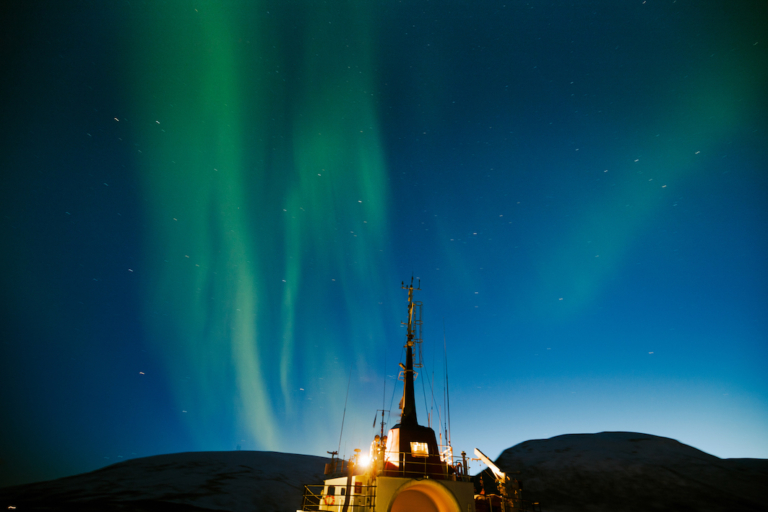
An extremely rare aurora has been observed in Spitsbergen
The phenomenon, never before observed from the Earth’s surface, is thought to be the result of a polar rain of electrons coming straight from the solar corona.
What is life like during the polar night?
People who live in Earth’s icy polar regions experience almost constant night every winter. This phenomenon is called the polar night, but what exactly is it? When does…
Where does the midnight sun come from?
The polar regions are known for the polar night, an almost unbroken winter night. In summer, on the other hand, the days grow longer and longer. The phenomenon…