10 sounds of the Arctic you will never forget
Traveling in the polar regions means learning to slow down and pay attention to details we often overlook in everyday life. In these places, where the absence of human noise is still possible, every sound takes on special meaning.
Aboard Polarfront, discovering the Arctic is not just about the extraordinary landscapes gliding past the ship, but also about its unique soundscape. A world of creaks, breaths, songs and murmurs that tell the story of a land in perpetual motion.
Because polar lands are not discovered with the eyes alone. You also have to know how to listen.
Come aboard with us for an immersive journey through ten iconic sounds that make a polar voyage so magical and turn it into an unforgettable adventure.
THE RUMBLE OF A GLACIER
At first glance, a glacier seems motionless. A vast river of ice frozen in the landscape, silent and eternal.
Yet behind this apparent calm lies a giant in constant motion. A glacier is not an inert mass: it is a river of ice that slowly advances under its own weight, gradually descending from the peaks to the valleys and sometimes all the way to the sea.
This movement is almost imperceptible on a human scale. Some glaciers advance a few meters a year, others much faster depending on how much snow feeds them, their slope and the climate. But this slow progress puts immense internal stress on the ice, which constantly cracks, compresses and rearranges itself.
That is when the glacier begins to “speak.”
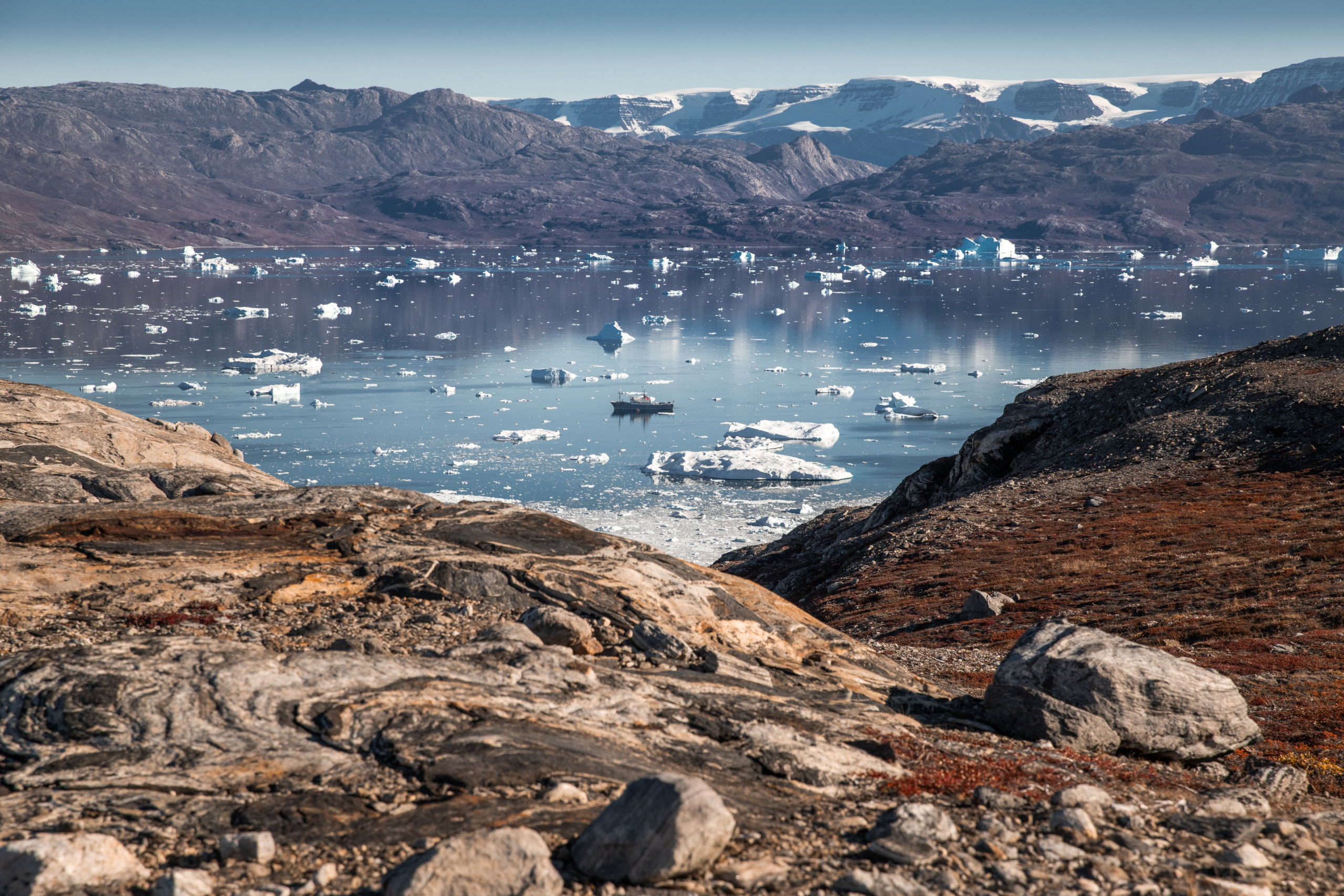
Deep cracks, muffled rumbles and mysterious vibrations sometimes run through the ice. These sounds can echo for several hundred meters, amplified by the steep walls of the fjords. They bear witness to the colossal forces silently at work in the heart of the glacier.
When the strain becomes too great, huge fractures open up. A slab of ice can then suddenly break away from the glacier front and crash into the sea: this is known as calving.
It is a breathtaking sight. With a tremendous roar, part of the glacier collapses into the water, sending a wave rippling across the surface of the fjord. For a few seconds, the whole landscape seems to tremble. Then silence returns, as if nothing had happened.
Watching a glacier calve is an experience that is hard to forget. The sound is powerful, almost unreal, but it also tells a story thousands of years old: that of snow piling up, slowly turning into ice, then being released by the sea.
In the polar regions, listening to a glacier means hearing time itself in motion.THE BLOW OF A WHALE IN THE SILENCE OF THE FJORD
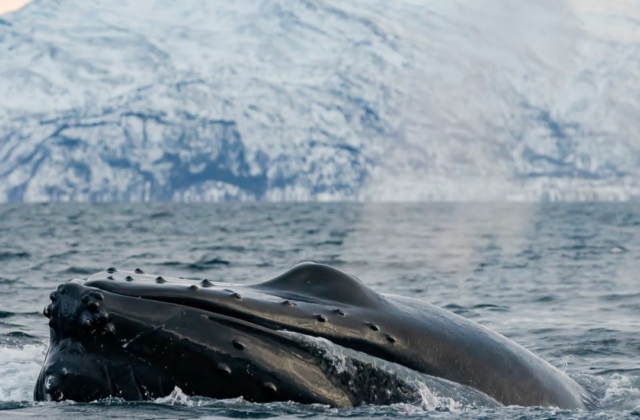
Deep in a fjord, when the sea is calm and the landscape seems frozen in silence, a short, powerful sound can suddenly break the stillness: the blow of a whale.
Even before you see the animal, it is often this distinctive sound that gives it away. A column of moist air shoots forcefully from the surface of the water as the whale comes up to breathe after spending several minutes at depth. In the cold Arctic air, this exhalation forms a cloud of condensation that hangs above the animal for a few moments, like a signature unique to each species.
This blow, known as the spout, is not water expelled from the lungs, as people sometimes imagine, but mostly warm air laden with water vapor that condenses on contact with the cold atmosphere. Its shape, height and duration can even help experienced observers identify the species: the tall, vertical blow of a fin whale looks nothing like the bushier one of a humpback.
Then comes the second part of the encounter: the silence before the whale reappears. A dorsal fin breaking the surface, an immense back slowly sliding through the water, sometimes a dive accompanied by one last powerful blow… Each appearance is fleeting, yet unforgettable.
These magical moments always feel special. The contrast between the vastness of the fjords, the snow-covered mountains and the presence of a giant of the sea is a reminder of how wild and unspoiled the Arctic Ocean still is.
From the deck of Polarfront or from a Zodiac, hearing a whale blow in the silence of the Far North is much more than a simple sound: it is the quiet sign of an encounter with one of the largest creatures on our planet.THE MURMUR OF THE SEA ICE AGAINST POLARFRONT’S HULL
Sailing in polar waters brings sensations you will find nowhere else. Among them is a very particular sound: ice gently meeting the ship’s hull.
As Polarfront makes her way between floes of sea ice or through waters scattered with small fragments of ice, the silence of the Arctic is sometimes broken by creaks, scraping and dull thuds against the hull.
These sounds, sometimes as soft as a whisper, sometimes louder when the floes are bigger, speak of an environment in constant motion.
The sea ice is never completely still. Driven by currents, wind and changes in temperature, it is constantly forming, drifting and changing.
Listening from the bridge or the outer deck as the ice accompanies Polarfront on her way is a unique experience: a silent dialogue between a ship born of the northern seas and an ocean shaped by thousands of years of natural cycles.
Much more than a simple sailing noise, it is the sound of an encounter between humans and a world that is still wild.
THE CLAMOR OF THE BIRD COLONIES ON THE CLIFFS OF SVALBARD
In summer, the Arctic becomes a vast nursery.
After the long, cold, dark months of winter, the return of the light sets off a true explosion of life. For just a few weeks, seabirds flock to the coasts of Svalbard to make the most of this exceptional time when food is plentiful and the sun no longer sets.
On the sheer cliffs lining the fjords, thousands of birds build their nests, sometimes in a space of just a few square meters. These rock faces become true vertical cities, where every ledge holds a family, every nook shelters a nest and every bird takes part in an incredible collective choreography.
Little auks, Brünnich’s guillemots, northern fulmars and kittiwakes all add their voices to this Arctic symphony. Their cries, calls and wingbeats mingle with the sea breeze and the roar of the waves against the cliffs.
From a distance, a colony can look almost motionless, like a simple dark smudge clinging to the rock. But as you approach by Zodiac, the scene changes completely: silence gives way to an incredible concert of sounds. Thousands of voices call back and forth, parents call to their young, pairs strengthen their bonds, and everyone seems to know their place in this immense community.
These calls play a vital role. In the constant hubbub of the colony, they help birds recognize their mate, find their nest and keep intruders away. Each species has its own calls, like so many sound signatures adapted to life in a crowd.
In the heart of the Arctic summer, the cliffs of Svalbard become much more than a refuge for birds: they are the stage for a unique sensory spectacle, where sight and sound combine to reveal the full richness of the polar world.
Watching a seabird colony from the sea and hearing all that bustle amid the wild landscapes of the fjords is to discover an Arctic far removed from the image of a frozen desert. A vibrant land, inhabited and deeply alive.THE CRUNCH OF OUR FOOTSTEPS IN THE SNOW
In the Arctic, some of the most memorable sounds are also the simplest.
Far from the noise of civilization, every move becomes a sensory experience. When you walk on fresh snow in Spitsbergen, a distinctive sound accompanies each step: a light crunch, sometimes muffled, sometimes crisper depending on the temperature and texture of the snow.
This familiar sound takes on special meaning here. In the white vastness of the tundra or at the foot of a glacier, it becomes almost the only human-made sound in a landscape shaped by nature.
Snow also tells us something about the climate. When it is cold and dry, its crystals rub against one another and produce that famous crunch underfoot. When it is wetter or more compact, it absorbs more sound and deepens the impression of absolute silence.
Walking in polar snow means moving through a world where you can hear almost every movement: the breath of the wind, a layer of ice cracking in the distance, the quiet sound of your own footsteps.
THE MYSTERIOUS SONG OF THE WHALES
Beneath the surface of the polar oceans, a true symphony is playing, invisible to human eyes but essential to the life of the great whales.
In the vastness of the sea, where light fades quickly with depth, whales use sound as their main means of communication. Unlike humans, who rely above all on sight, cetaceans have developed an exceptionally rich acoustic world: their calls can travel great distances underwater, allowing them to stay in touch, recognize one another, find a mate or coordinate their movements.
Humpback whales are probably the most famous for their songs. The males produce long sound sequences made up of repeated patterns, shifts in frequency and complex rhythms. These songs, which can last for tens of minutes, change over the years: true cultural traditions seem to pass between populations, with each group having its own musical variations.
In sperm whales, communication takes another form. They use series of rhythmic clicks called codas, whose organization still intrigues scientists. Recent research suggests that these sequences may contain complex structures reminiscent of certain aspects of human language.
Listening to these sounds means connecting with a world our ears usually cannot perceive.
Aboard a polar ship, hearing a whale blow at the surface or picking up its calls underwater with a hydrophone is a rare experience: listening to a language that has existed since long before humans appeared.
Because sometimes, even before you see a whale, you can meet it through sound.
Did you spot it?During his time aboard Polarfront, the musician Thylacine recorded whale songs to feed his creative work. These calls were then woven into his track “Polar.”
Can you spot the moment when the whale songs slip into the music?
THE CLASH OF SVALBARD REINDEER ANTLERS
Across the vast tundra landscapes of Svalbard, the Svalbard reindeer (Rangifer tarandus platyrhynchus) often moves in small groups, searching for the few plants that manage to grow in this extreme environment.
At first glance, these animals seem to live in absolute silence. Yet at certain times of year, the tundra echoes with a very particular sound: the sharp clack of their antlers clashing.
In the fall, during the rut, males use their antlers to impress their rivals and establish dominance. The clashes are rarely violent, but the blows ring out across the landscape, blending strength and grace in a ritual thousands of years old.
Reindeer antlers are fascinating in themselves: they grow every year in spring, covered in a soft skin called “velvet,” before gradually hardening and then falling off after the breeding season.
Seeing a Svalbard reindeer in its natural environment is already a rare encounter. But hearing the sound of its antlers in the silent vastness of the Arctic is one of those moments that stay etched in your memory.
THE BREATH OF THE WALRUSES
Walruses are particularly fascinating in the water. Despite their massive bulk, they move with surprising ease beneath the surface, diving to feed before regularly coming up to breathe. In groups, they often stay close together and communicate with a wide variety of sounds: deep grunts, whistles, cries and calls that carry both under and above the water. For observers in a Zodiac, these interactions put on a show for the ears as much as for the eyes, as you sense the animals’ presence before you even see them clearly.
But it is above all when walruses come up for air that their presence becomes truly striking. Their powerful breath bursts from their nostrils with a deep, hoarse sound, sometimes with a splash when they surface quickly. Several animals may breathe just a few meters apart, creating a series of breaths that punctuate the calm of the ocean. Between dives, the walruses gather, follow one another and interact at the surface, before disappearing underwater again. Listening to their breathing, their calls and the movements of the group reveals another side of their lives: that of an active, social and surprisingly expressive marine community.Have you ever heard the sounds walruses make underwater?
Using a hydrophone, the Polarfront guides were able to record their calls and share them with guests.
Now it is your turn: listen to this rare recording below.
THE LAPPING OF WATER AGAINST A ZODIAC
Not all the sounds of the Arctic are made by animals or ice.
Sometimes the most beautiful sound is simply that of the water.
Aboard a Zodiac, when the engine is cut to quietly approach a glacier, a bird colony or a group of walruses, silence immediately takes over again. The lapping of the waves against the hull then becomes the soundtrack of the exploration.
With every gentle swell, the water strokes the boat in a soothing rhythm. Small pieces of drifting ice, polished by the currents, knock gently against one another or slide along the hull with a crystal-clear tinkle. Sometimes a wave gently lifts the boat, a reminder that everything is moving, even when the landscape seems still.
In this slow navigation, sounds take on a new dimension. You can make out the blow of a whale in the distance, the cries of birds nesting on the cliffs or the quiet rumble of a glacier. Every sound seems more intense, carried by the near-total absence of noise pollution.
The Zodiac then becomes much more than a means of transportation: it offers a unique closeness to nature. Just a few centimeters above the water, you feel literally immersed in the landscape, in the heart of the fjords and the ice.
It is often in these moments when time stands still, as the boat drifts almost silently among icebergs and mountains, that you fully grasp the magic of the Arctic. The simple lapping of the water then accompanies one of the greatest privileges of a polar voyage: spending a few hours in a world where nature still sets the pace.THE ABSOLUTE SILENCE OF THE ARCTIC
Paradoxically, the most striking sound of the Arctic may be… the absence of sound.
In the high latitudes, far from cities, roads and all human bustle, silence becomes a true sensory experience. It is like no other. Immense, deep, almost tangible, it envelops the landscape and naturally invites you to slow down, observe and listen differently.
Over the days at sea or during a landing on the shores of Svalbard, you come to realize that this silence is not a void. On the contrary, it is filled with a multitude of quiet sounds that our everyday lives usually drown out.
In this unspoiled world, every sound becomes an event. Each one tells of the presence of an animal, the movement of the ice or the rhythm of the elements. Little by little, you learn to listen differently, to savor the silences between two breaths, between two waves, between two bird calls.
This living silence is no doubt one of the Arctic’s greatest treasures. It brings a rare, almost meditative sense of calm, and reminds us how powerful nature can be without ever being loud.
Aboard Polarfront, many travelers bring up this memory long after they get home: not a particular landscape or a special encounter, but the unique feeling of having heard… silence.
Because in the Far North, silence is never an absence. It is the voice of nature.Sail to Spitsbergen
aboard Polarfront
Twelve guests, a seasoned crew and passionate guides: the upcoming departures.
10 days / 9 nights Spitsbergen · WildlifePolar spring in Spitsbergen 12 of 12 spots from€12,490 25Apr2027 returning May 4 Spring
10 days / 9 nights Spitsbergen · WildlifePolar spring in Spitsbergen 5 of 12 spots from€12,490 4Aug2027 returning Aug 13 Summer
10 days / 9 nights Spitsbergen · WildlifeMidnight sun in Svalbard 11 of 12 spots from€12,620 19Sep2027 returning Sep 26 Fall
8 days / 7 nights Spitsbergen · Northern lightsAutumn escape to Svalbard 12 of 12 spots from€9,720 26Sep2027 returning Oct 4 Fall
9 days / 8 nights Spitsbergen · Northern lightsAutumn lights in Svalbard 10 of 12 spots from€11,110 4Oct2027 returning Oct 12 Fall
9 days / 8 nights Spitsbergen · Northern lightsAutumn lights in Svalbard 12 of 12 spots from€11,110
No upcoming departures for this selection.
Polar bears in Spitsbergen: where and when to see them
Seeing a polar bear in the wild is the dream of many travelers heading to Spitsbergen. The archipelago is one of the best places in the world to…
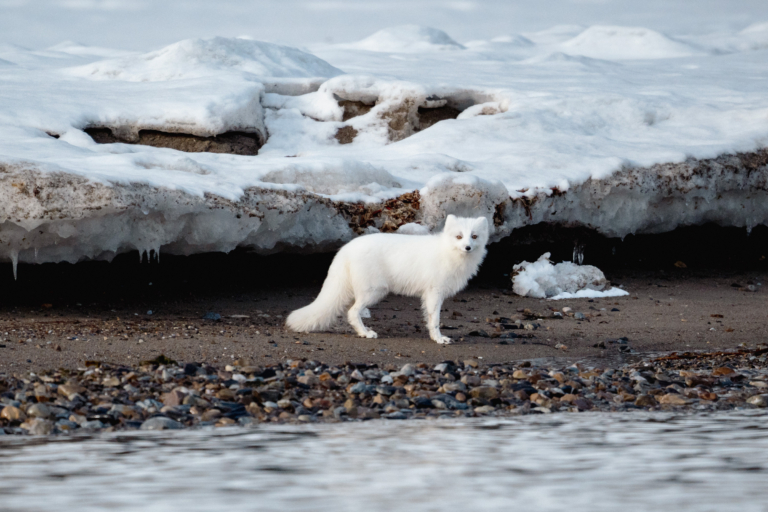
Arctic fox: how does it survive in one of the most hostile environments on the planet?
In the white vastness of the Arctic, a discreet silhouette sometimes crosses the snow-covered tundra. Fast, agile and perfectly camouflaged, the Arctic fox (Vulpes lagopus) is one of…
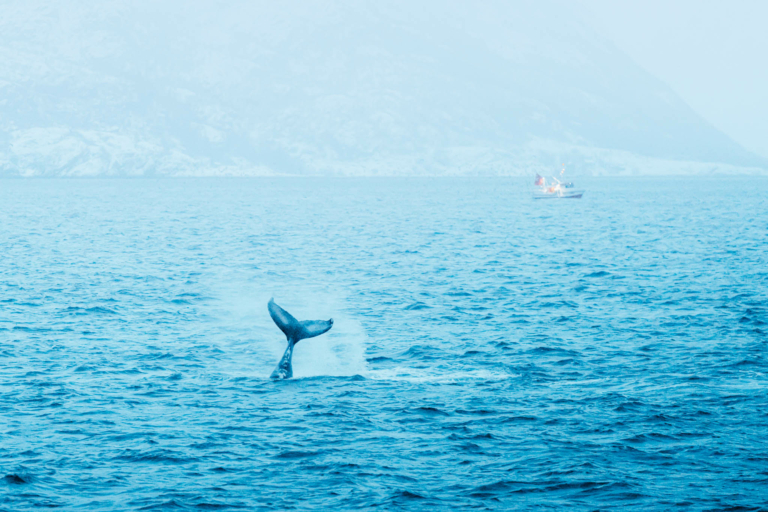
Could whales one day talk to us?
Humankind has always dreamed of communicating with the other species we share our planet with. Understanding birdsong, interpreting the signals of primates or decoding the sounds of the…