15 fun facts about orcas
With its black-and-white coat, the orca is instantly recognizable. An animal of superlatives, it is the only species that can take on the great white shark. But behind the oceans’ apex predator lies a mammal that is harmless to humans and deeply attached to its family. Here are 15 fun facts that will make you want to go and see these incredible cetaceans aboard Polarfront even more!
1. The orca is not a whale but a dolphin
Despite its impressive size and its nickname, “killer whale,” the orca is a dolphin. It belongs to the family Delphinidae, which appeared in the Miocene, 11 or 12 million years ago. This family is part of the odontocetes (toothed whales), as opposed to the mysticetes (baleen whales), such as the great whales.
2. The orca is the second most widespread mammal in the world
The orca’s range covers every ocean on the planet, from the Arctic to the Antarctic. Although it prefers cold water, it is also found in warm waters along the equator, including around the Hawaiian and Galápagos Islands. It also turns up in semi-enclosed seas such as the Mediterranean, the Gulf of California, the Gulf of Mexico, the Red Sea and the Persian Gulf. Its distribution is so vast that the orca is considered the most widespread mammal in the world, after humans.
3. Orcas are family-minded
Orcas are social animals that cannot live alone. Most of them spend their whole lives in the same community of 20 to 50 individuals. Orca groups are among the most stable in the entire animal kingdom. Populations are led by a matriarch, and the young are raised by their mother and grandmother, whose experience helps ensure their survival. In years when food is scarce, for example, the elders show the young where to travel to find food for the whole family.
4. The orca is the largest dolphin in the world
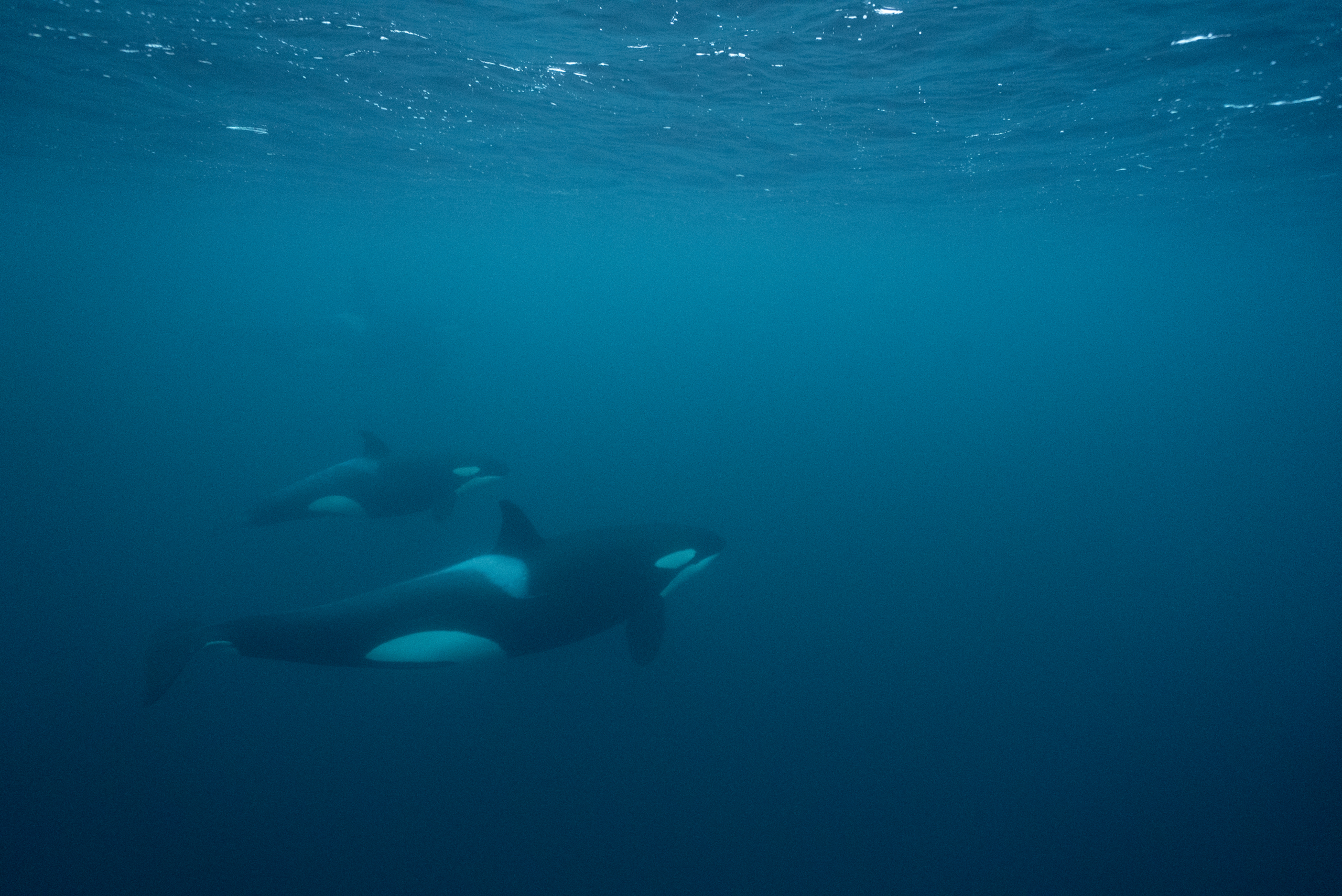
This marine mammal weighs 5 to 7 tons and measures 5 to 9 m long, with females smaller than males. The longest specimen on record measured 9.74 m and the heaviest weighed 11 tons. Its impressive size makes the orca the largest dolphin in the world. Its French nickname, épaulard, comes from its pointed dorsal fin, which looks like a shoulder (épaule) and can reach 2 m. Unlike most dolphins, its tail fluke is broad and rounded and can span 2.40 m. At birth, an orca weighs 150 to 220 kg and measures between 2 and 2.70 m long.
5. Orcas are black and white for camouflage
Over the course of evolution, the orca’s sharply defined markings have become disruptive coloration that helps it hunt more effectively. Seen from above, its black back blends into the dark depths. The orca becomes almost invisible to animals resting on the ice, such as seals and penguins. Its white belly cannot be made out by species swimming below it, dazzled as they are by the light reflecting off the water. And its eye patches complete the camouflage outfit.
6. Wild orcas are harmless to humans
Following accidents at marine parks, the orca has a reputation as a killer of humans. In the wild, however, it behaves very peacefully toward people. Like other dolphins, the orca is so curious that it will approach boats in an attempt to make contact. Remember that the orca is a social animal that needs to live in a group in vast natural spaces. Confined to small, unsuitable tanks, it can become depressed and aggressive. In fact, all fatal attacks have happened in captivity.
7. Orcas can lunge onto land
A voracious animal, the orca will go to great lengths to catch its prey. It does not hesitate to throw itself out of the water to grab a sea lion on the shore. This hunting technique, observed in the Southern Hemisphere, involves building up enough speed in the water, then suddenly surging out of the ocean to seize the victim on land. Once it has snatched its prey, the orca wriggles back into the sea with powerful twists of its body.
8. The orca is the shark’s only enemy
Sharks are often said to sit at the top of the food chain, but they still need to be on their guard around orcas. The orca is the only known natural predator of the great white shark. Scientists have filmed orcas devouring these formidable fish off the coast of South Africa. Similar video footage has also been captured in Australian waters. Orcas use their powerful jaws and sharp teeth to inflict fatal wounds on the sharks, then eat their liver, a nutrient-rich organ.
9. The orca has no predators
True to its nickname, the killer whale reigns supreme at the top of the ocean food chain and, as such, has no natural enemies. Like other cetaceans, this social species almost always hunts in groups and can eat up to 230 kg of food a day. Its highly varied menu includes schools of all kinds of fish, penguins, auks, many marine mammals (sea lions, fur seals, seals, porpoises, small whales, manatees, dolphins), seabirds, cephalopods (squid, cuttlefish, octopus), sea turtles and even sharks, as we have seen. Its diet is estimated to include more than 80 prey species.
10. Orcas hunt by echolocation
On top of sharp eyesight and keen hearing, the orca uses echolocation to find its way. This ability lets it determine the size and location of prey without seeing it. To do so, the orca emits sounds that travel underwater until they hit an obstacle. As they bounce back, the sounds give it detailed information about the object. Since the orca has no predators, this information tells it whether to hunt that prey or look for a more worthwhile catch.
11. Each clan has its own language
Communication is very important for these cetaceans, which spend a lot of time interacting through calls and physical contact. These highly social animals use a complex series of whistles, pulsed calls and clicks to communicate. The sounds they make can vary in volume, wavelength, frequency and pattern. While the signals of different groups share similarities, scientists have detected variations specific to each pod (a family group made up of several generations of males and females). It is, in a way, a dialect unique to each clan.
12. Orcas go through menopause too
Most animal species can reproduce until the end of their lives. Only 6 animals (humans and 5 species of toothed whales, including the orca) are the exception. According to a study by scientists at the University of Exeter in England, this phenomenon is linked to orcas’ social practices aimed at keeping the group together. Siblings stay together throughout adulthood. So instead of continuing to reproduce, aging females keep devoting themselves to the group, guiding every generation: children, grandchildren and great-grandchildren.
13. Orcas have very heavy brains
Weighing in at nearly 7 kg, the orca’s brain is the second heaviest of all marine mammals. In this category, it is surpassed only by the sperm whale, which has the heaviest brain in the animal kingdom, at nearly 8 kg. By comparison, an adult human brain weighs between 1.2 and 1.4 kg.
14. Orcas sleep with one eye open
Like many marine animals, the orca has to come up to the surface to breathe. When it sleeps, half of its brain stays alert. This kind of rest, called unihemispheric slow-wave sleep, requires it to close the eye on the side opposite the sleeping half of the brain. The orca must also keep its blowhole closed to keep water out. The awake half tells the orca when it is time to surface to breathe and keeps watch for any danger. After about 2 hours, the orca switches sides so that both halves of the brain get some rest. These short periods of sleep are a lot like our naps.
15. In the wild, orcas can live for a century!
The oldest orca known to date was a female, over 100 years old, named Granny, or J2, who lived in the North Pacific. She was first identified in the 1970s off Vancouver, thanks to a very distinctive white mark on her back and a notch in her fin. With her family (children, grandchildren and great-grandchildren), she lived in the coastal waters of Washington State and British Columbia, as well as in the inland waters of those regions. The matriarch was last seen in October 2016. After many months without a sighting, scientists presumed her dead at the age of 105. In the wild, the maximum life expectancy of a female is about 80 to 90 years, and of a male 50 to 60 years. Constrained by the size of their tanks, orcas in captivity live half as long as in the wild, 35 years at most.
By Nathalie Truche, Le mag des animaux (Ouest France), published November 29, 2023
Sail to the Far North
aboard Polarfront
Twelve guests, a seasoned crew and passionate guides: the upcoming departures.
8 days / 7 nights Norway · Northern lightsPhoto voyage in Norway 11 of 12 spots Promo from€2,585 20Dec2026 returning Dec 28 Winter
9 days / 8 nights Norway · Northern lightsWinter magic in Norway 7 of 12 spots Promo from€2,975 28Dec2026 returning Jan 5 Winter
9 days / 8 nights Norway · Northern lightsWinter magic in Norway Only 3 spots left from€5,950 28Feb2027 returning Mar 7 Winter
8 days / 7 nights Norway · Northern lightsNorwegian gems in spring 8 of 12 spots from€5,280 16Apr2027 returning Apr 25 Spring
10 days / 9 nights Spitsbergen · WildlifePolar spring in Spitsbergen 12 of 12 spots from€12,490 25Apr2027 returning May 4 Spring
10 days / 9 nights Spitsbergen · WildlifePolar spring in Spitsbergen 5 of 12 spots from€12,490 4Aug2027 returning Aug 13 Summer
10 days / 9 nights Spitsbergen · WildlifeMidnight sun in Svalbard 11 of 12 spots from€12,620 22Aug2027 returning Sep 1 Summer
11 days / 10 nights Greenland · Northern lightsNortheast Greenland National Park Last spot from€13,880 19Sep2027 returning Sep 26 Fall
8 days / 7 nights Spitsbergen · Northern lightsAutumn escape to Svalbard 12 of 12 spots from€9,720 26Sep2027 returning Oct 4 Fall
9 days / 8 nights Spitsbergen · Northern lightsAutumn lights in Svalbard 10 of 12 spots from€11,110 4Oct2027 returning Oct 12 Fall
9 days / 8 nights Spitsbergen · Northern lightsAutumn lights in Svalbard 12 of 12 spots from€11,110 10Dec2027 returning Dec 18 Winter
9 days / 8 nights Norway · Northern lightsWinter magic in Norway 12 of 12 spots from€6,040 18Dec2027 returning Dec 26 Winter
9 days / 8 nights Norway · Northern lightsWinter magic in Norway 12 of 12 spots from€6,220 26Dec2027 returning Jan 3 Winter
9 days / 8 nights Norway · Northern lightsWinter magic in Norway 12 of 12 spots from€6,220
No upcoming departures for this selection.
Polar bears in Spitsbergen: where and when to see them
Seeing a polar bear in the wild is the dream of many travelers heading to Spitsbergen. The archipelago is one of the best places in the world to…
10 sounds of the Arctic you will never forget
Traveling in the polar regions means learning to slow down and pay attention to details we often overlook in everyday life. In these places, where the absence of…
Arctic fox: how does it survive in one of the most hostile environments on the planet?
In the white vastness of the Arctic, a discreet silhouette sometimes crosses the snow-covered tundra. Fast, agile and perfectly camouflaged, the Arctic fox (Vulpes lagopus) is one of…