How do whales swallow their food without drowning?
Scientists have studied the mechanisms that allow baleen whales to swallow their food underwater without drowning. They present their conclusions in a new study.
Opening an enormous mouth to engulf thousands of liters of water… without ever flooding your lungs. At first glance, it seems impossible. And yet baleen whales pull off this feat several hundred times a day when they feed.
How do these ocean giants manage to swallow their food underwater without drowning? For a long time, the mechanism remained a real mystery. A study led by biologists at the University of British Columbia, in Canada, and published in the journal Current Biology, now offers a fascinating answer.
Whales gulp down… thousands of liters of water
Baleen whales, such as the humpback whale, the fin whale and the blue whale, feed mainly on krill, small shrimp-like crustaceans, as well as on small fish.
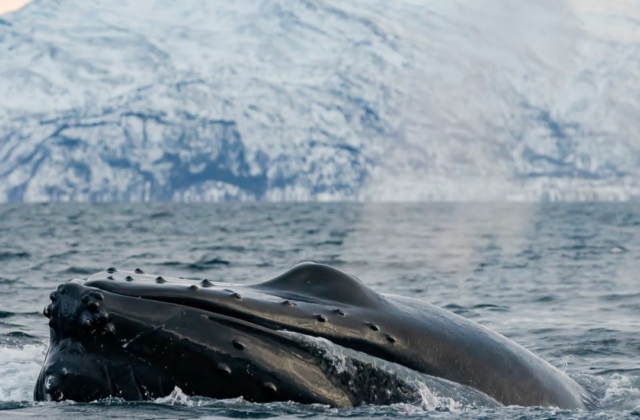
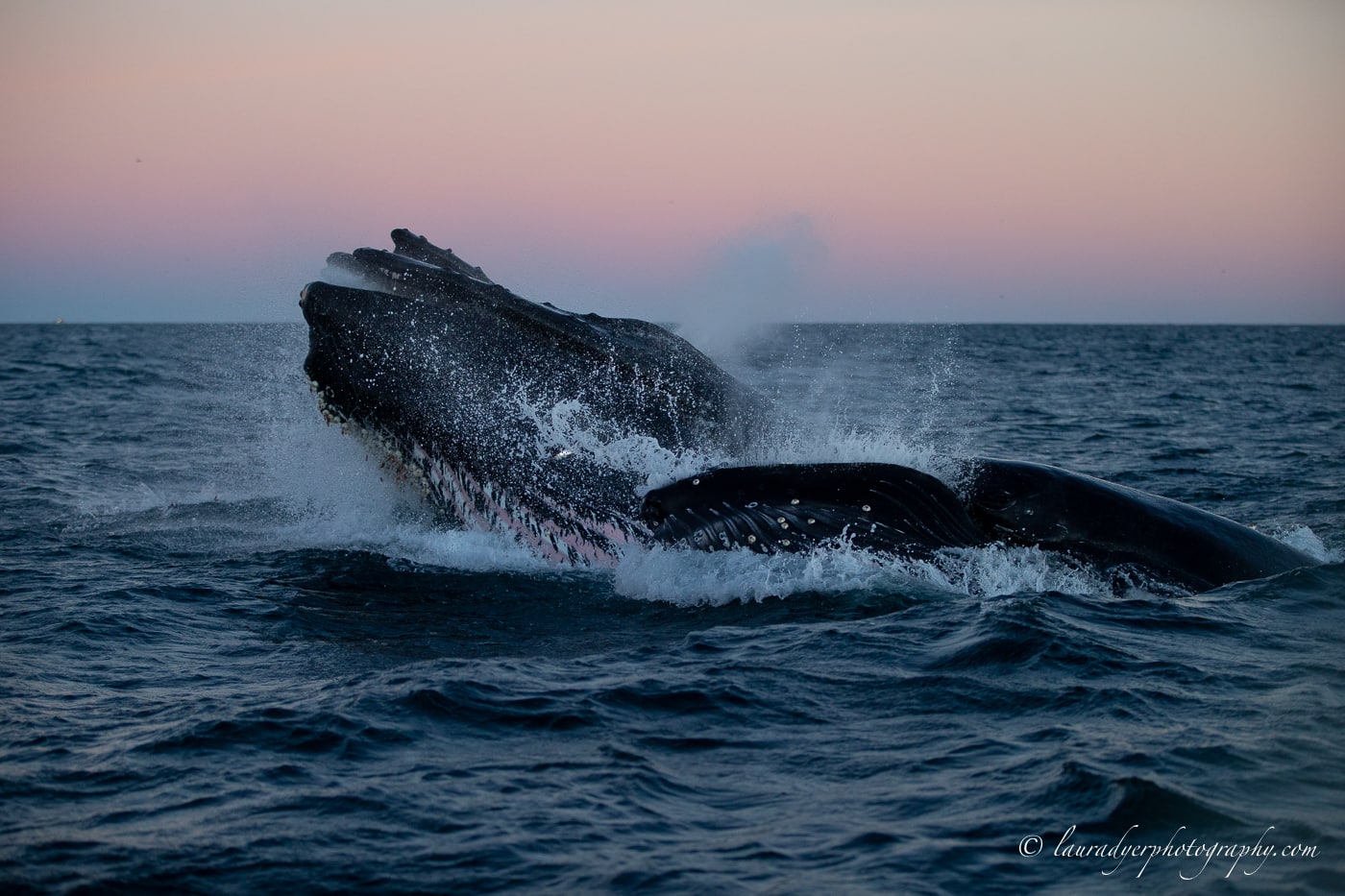
When they spot a school of prey, they use a spectacular technique called engulfment feeding (lunge feeding). They suddenly speed up, open their gigantic mouths and swallow an impressive amount of water and food in one go.
Some large whales can take in a volume of water equivalent to a small swimming pool: several tens of thousands of liters in a single mouthful.
This naturally raises a question: how does all that water stay out of their airways?
The discovery of a surprising “oral plug”
The researchers identified a previously unknown anatomical structure: a buccal plug (oral plug).
Located at the back of the mouth, this fleshy tissue acts as a true safety valve. When the whale opens its mouth to capture its food, the plug seals off access to the pharynx, preventing water from reaching the lungs.
When the whale swallows, the mechanism shifts subtly. The plug moves to close off the nasal cavity, while the laryngeal sac protects the lower airways. A protected passage then opens between the mouth and the esophagus, allowing the food to reach the stomach without water flooding the respiratory system.
In other words, the whale can swallow underwater while keeping its lungs perfectly protected.
Then the baleen goes to work
Before it is swallowed, the food has to be separated from the water.
That is the job of the baleen, the long plates of keratin that take the place of teeth in the great filter-feeding whales.
After closing its mouth, the whale contracts its tongue and pushes the water out through the baleen. The baleen works like a giant sieve: the water flows out, while the krill and small fish are trapped in its fine fringes before being swallowed.
This filtering system is remarkably efficient, and it allows the largest animals that have ever lived on Earth to meet their enormous energy needs.
A discovery unique in the animal kingdom
According to the study’s authors, no comparable anatomical structure had ever been observed in any other animal.
“We discovered a structure in fin whales that probably exists in all whales that gulp their food with their mouths wide open,” explains biologist Kelsey Gil, the study’s lead author.
She compares the mechanism to what happens when we humans swallow: our soft palate closes off the nasal passages while the epiglottis protects the trachea, keeping food out of the lungs. In whales, the principle is similar, but it has evolved to work in an entirely aquatic environment, with gigantic volumes of water.
Why did this discovery take so long?
You might think that an animal as iconic as the whale has few secrets left to reveal. Yet its anatomy remains difficult to study.
Great whales spend most of their lives far out at sea and sometimes dive several hundred meters deep, and it is obviously impossible to observe their digestive or respiratory systems while they are alive.
Scientists therefore have to work with stranded animals or animals that died of natural causes. By carefully studying their tissues and anatomy, they reconstruct how the various organs work, a discipline called functional morphology.
As Kelsey Gil points out, “it’s impossible to study this mechanism in a living whale. We have to rely on tissue from dead animals to understand the role of each anatomical structure.”
Whales never cease to surprise us
This discovery is a reminder of just how extraordinary whales remain. Despite decades of research, they keep revealing astonishing adaptations, shaped by millions of years of evolution.
The “oral plug” is a remarkable example of this natural engineering. Thanks to it, whales can engulf huge quantities of water, filter their food efficiently and breathe safely: a balance essential to the survival of the largest marine mammals on our planet.
Each new discovery brings us a little closer to understanding these ocean giants… while reminding us that they still keep much of their mystery.Sail to Norway
aboard Polarfront
Twelve guests, a seasoned crew and passionate guides: the upcoming departures.
8 days / 7 nights Norway · Northern lightsPhoto voyage in Norway 11 of 12 spots Promo from€2,585 20Dec2026 returning Dec 28 Winter
9 days / 8 nights Norway · Northern lightsWinter magic in Norway 7 of 12 spots Promo from€2,975 28Dec2026 returning Jan 5 Winter
9 days / 8 nights Norway · Northern lightsWinter magic in Norway Only 3 spots left from€5,950 28Feb2027 returning Mar 7 Winter
8 days / 7 nights Norway · Northern lightsNorwegian gems in spring 8 of 12 spots from€5,280 10Dec2027 returning Dec 18 Winter
9 days / 8 nights Norway · Northern lightsWinter magic in Norway 12 of 12 spots from€6,040 18Dec2027 returning Dec 26 Winter
9 days / 8 nights Norway · Northern lightsWinter magic in Norway 12 of 12 spots from€6,220 26Dec2027 returning Jan 3 Winter
9 days / 8 nights Norway · Northern lightsWinter magic in Norway 12 of 12 spots from€6,220
No upcoming departures for this selection.
Polar bears in Spitsbergen: where and when to see them
Seeing a polar bear in the wild is the dream of many travelers heading to Spitsbergen. The archipelago is one of the best places in the world to…
10 sounds of the Arctic you will never forget
Traveling in the polar regions means learning to slow down and pay attention to details we often overlook in everyday life. In these places, where the absence of…
Arctic fox: how does it survive in one of the most hostile environments on the planet?
In the white vastness of the Arctic, a discreet silhouette sometimes crosses the snow-covered tundra. Fast, agile and perfectly camouflaged, the Arctic fox (Vulpes lagopus) is one of…