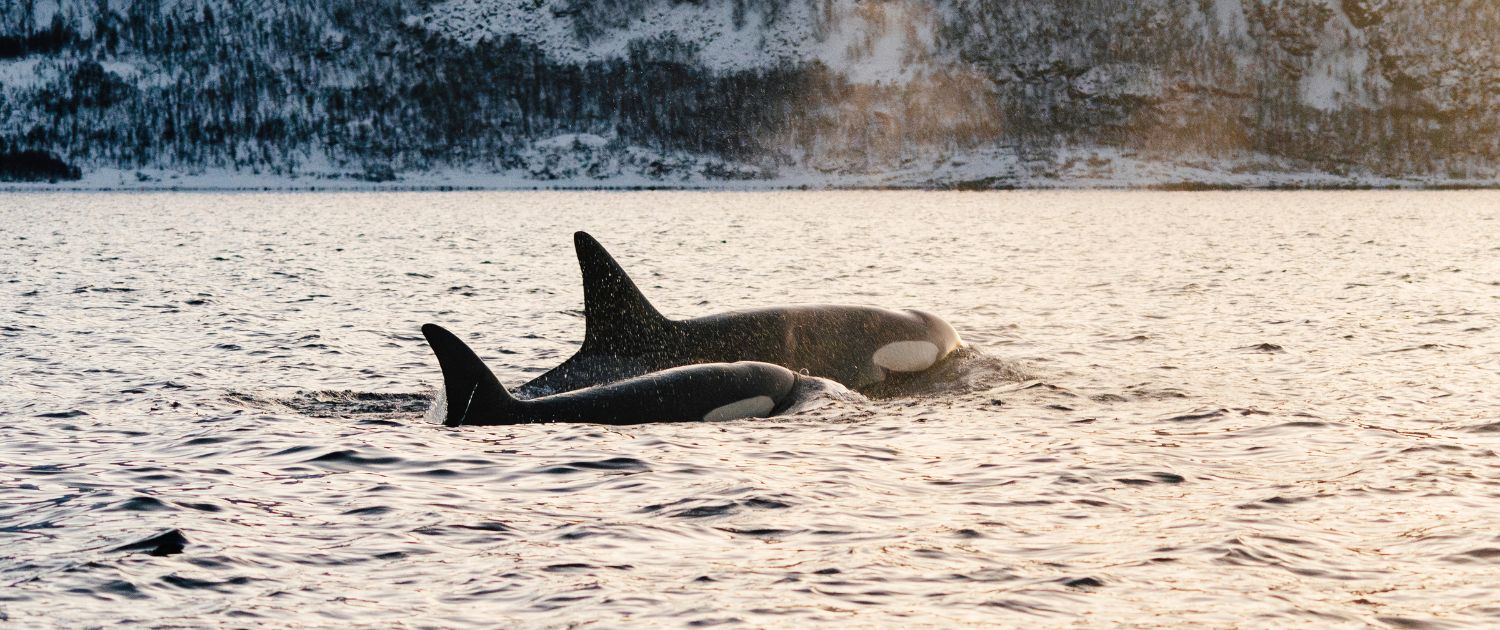
Why is the orca called the killer whale?
Fast, powerful, organized and remarkably intelligent, orcas sit at the top of the marine food chain. No natural predator threatens them, and few animals can escape them.
But their strength does not lie in physical power alone.
What truly makes orcas the queens of the oceans is above all their extraordinary ability to cooperate, to learn and to devise incredibly sophisticated hunting strategies. Some populations even use techniques passed down from generation to generation, a behavior scientists regard as a genuine form of culture.
One of the most highly developed intelligences in the animal kingdom
Orcas (Orcinus orca) have one of the largest brains of any mammal.
Their intelligence shows in many aspects of their daily lives: communication, cooperation, learning, memory and problem-solving.
They live in tight-knit family groups called pods, led by an experienced female. The young often stay with their mother for life, gradually learning the behaviors they need to survive.
As with humans, elephants and some great apes, knowledge is not dictated by instinct alone: it is also passed on through experience.
Scientists call this animal culture.
Each orca population thus develops its own hunting techniques, its own eating habits and even its own dialects, made up of specific calls that allow members of the same group to recognize one another.
Hunters that can anticipate their prey
Orca hunting is anything but improvised.
Before attacking, they observe their prey, gauge its reactions and coordinate their movements with remarkable precision.
Their goal is simple: get as much food as possible while spending as little energy as possible.
To do so, they cooperate, divide up roles and adapt their strategy to the species they are chasing.
This ability to anticipate explains their exceptional success rate.
Spectacular “carousel feeding” in Norway
One of the most impressive techniques can be seen every winter in the fjords of Norway, when huge schools of herring migrate toward the coast.
The orcas then use a strategy known as carousel feeding.
It all starts with teamwork.
The orcas gradually encircle a vast school of herring to squeeze it up against the surface. The trapped fish form a huge, tight ball known as a bait ball.
The whales then circle the school like a merry-go-round, cutting off any escape.
Then comes the decisive moment.
Taking turns, the orcas strike the fish hard with their powerful tail flukes. The blow stuns several herring at once, which are then picked up one by one.
This technique allows them to catch large numbers of fish while greatly reducing the effort of the hunt.
Techniques tailored to each prey
Herring are just one example among many.
Depending on the region of the world, orcas adapt their behavior to their prey.
Some populations work together to create powerful waves that can knock seals off the ice floes where they have taken refuge.
Others chase dolphins for several kilometers until they are exhausted.
Some even attack whales much larger than themselves. Several orcas then work together to separate a calf from its mother before coordinating their attack.
Every hunt is carefully organized, proof of remarkable collective intelligence.
The only ones able to overpower a great white shark
Among the most astonishing feats of orcas is their ability to hunt great white sharks.
Observations off South Africa, and more recently in Australia, show that some orcas have developed a particularly effective technique.
They flip the shark onto its back, triggering a phenomenon called tonic immobility.
In this state, the shark is temporarily paralyzed and unable to defend itself.
The orcas then take advantage of this immobility to remove only the most energy-rich organs, especially the liver, which is particularly rich in lipids.
This technique shows not only how well they know their prey’s behavior, but also how well they can exploit its weak points.
A culture passed down from generation to generation
One of the most fascinating things about orcas is their ability to pass on their knowledge.
The young spend several years watching the adults before mastering the different hunting techniques.
Each group therefore has its own traditions.
Some populations feed almost exclusively on salmon, others prefer marine mammals, while some specialize in hunting rays or sharks.
These differences cannot be explained by prey availability alone.
They are, above all, cultural.
Scientists now consider orcas one of the few animal species able to pass on a true behavioral heritage from one generation to the next.
The undisputed queens of the oceans
Thanks to their intelligence, their cooperation and their extraordinary adaptability, orcas hold a unique place in the marine world.
Their physical strength allows them to take on almost any species, but it is above all their strategy that makes them so formidable.
Every hunt is the result of precise coordination, effective communication and learning built up over the years.
Far from the simplistic image of the “killer whale,” orcas now appear as predators of exceptional sophistication. They remind us that in the oceans, success depends not only on strength… but also on intelligence.Sail to Norway
aboard Polarfront
Twelve guests, a seasoned crew and passionate guides: the upcoming departures.
8 days / 7 nights Norway · Northern lightsPhoto voyage in Norway 11 of 12 spots Promo from€2,585 20Dec2026 returning Dec 28 Winter
9 days / 8 nights Norway · Northern lightsWinter magic in Norway 7 of 12 spots Promo from€2,975 28Dec2026 returning Jan 5 Winter
9 days / 8 nights Norway · Northern lightsWinter magic in Norway Only 3 spots left from€5,950 28Feb2027 returning Mar 7 Winter
8 days / 7 nights Norway · Northern lightsNorwegian gems in spring 8 of 12 spots from€5,280 10Dec2027 returning Dec 18 Winter
9 days / 8 nights Norway · Northern lightsWinter magic in Norway 12 of 12 spots from€6,040 18Dec2027 returning Dec 26 Winter
9 days / 8 nights Norway · Northern lightsWinter magic in Norway 12 of 12 spots from€6,220 26Dec2027 returning Jan 3 Winter
9 days / 8 nights Norway · Northern lightsWinter magic in Norway 12 of 12 spots from€6,220
No upcoming departures for this selection.

Polar bears in Spitsbergen: where and when to see them
Seeing a polar bear in the wild is the dream of many travelers heading to Spitsbergen. The archipelago is one of the best places in the world to…

10 sounds of the Arctic you will never forget
Traveling in the polar regions means learning to slow down and pay attention to details we often overlook in everyday life. In these places, where the absence of…
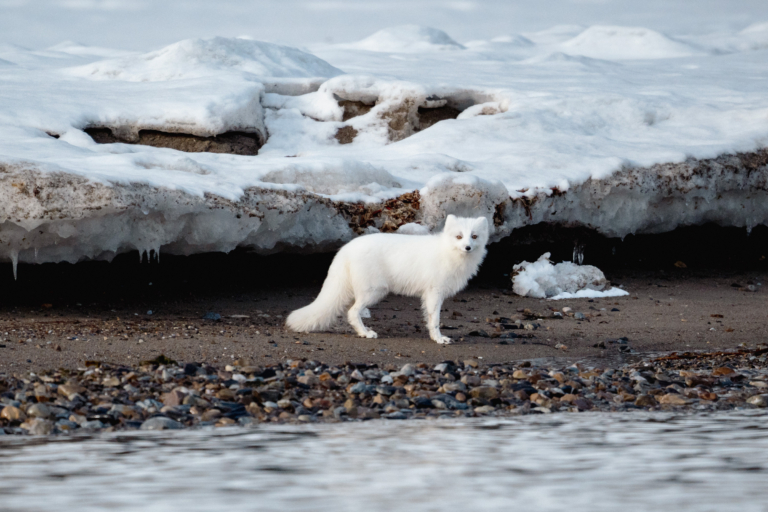
Arctic fox: how does it survive in one of the most hostile environments on the planet?
In the white vastness of the Arctic, a discreet silhouette sometimes crosses the snow-covered tundra. Fast, agile and perfectly camouflaged, the Arctic fox (Vulpes lagopus) is one of…