
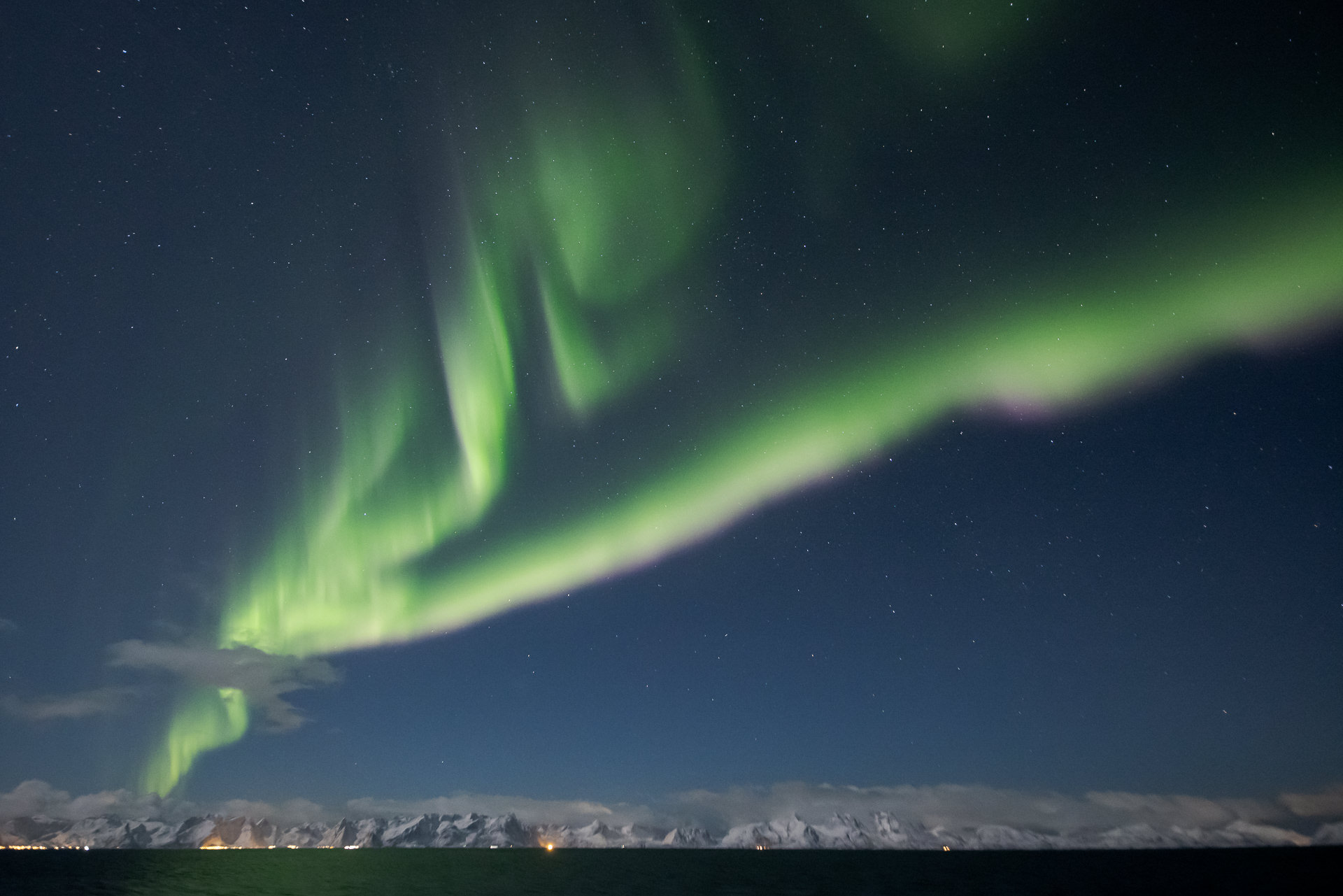
How can the northern lights be explained simply?
Why do the northern lights appear? The fascinating battle between the Sun and the Earth
Green curtains rippling across the sky, red veils setting the horizon ablaze, delicate shades of violet that seem to dance above snow-capped mountains… The northern lights are among the most fascinating natural spectacles on our planet. Every winter, travelers from all over the world head to Norway, Iceland, Finland, Canada or Spitsbergen in the hope of witnessing this dance of light.
But behind this almost unreal beauty lies a phenomenon of unsuspected violence.
The northern lights are in fact the result of a full-scale bombardment of our planet by particles from the Sun. Without the formidable magnetic shield that surrounds the Earth, these particles could damage our satellites and our power grids… and even make life as we know it much more difficult.
It all begins on the surface of the Sun
The Sun is far from a calm star.
It constantly hurls a huge stream of electrically charged particles out into space, mainly electrons and protons. This continuous flow is called the solar wind.
These particles travel at speeds ranging from 300 to more than 800 kilometers per second. During powerful solar flares or coronal mass ejections, they can be even more numerous and far more energetic.
After a journey of two to four days through space, part of this solar wind reaches the Earth.
The magnetosphere: our planet’s invisible shield
Fortunately, our planet has natural protection: the magnetosphere.
Generated by movements in the Earth’s metallic core, it acts as an immense magnetic field that deflects most of the solar particles.
You can picture it as a gigantic invisible bubble surrounding the planet.
Under the pressure of the solar wind, this bubble is never perfectly round. It is compressed on the side facing the Sun and stretched out behind, a bit like a soap bubble in a strong wind, or a rubber band being slowly pulled.
When the tension becomes too great, the magnetic field lines suddenly reconnect in a process called magnetic reconnection.
This snapping back of the “rubber band” flings some of the particles toward the polar regions at dizzying speeds.
Why do auroras appear near the poles?
Particles from the solar wind don’t enter the atmosphere at random.
They are guided by the lines of the Earth’s magnetic field, which naturally converge toward the North and South Poles.
That is why auroras are mainly visible in regions close to the polar circles, notably in Norway, Sweden, Finland, Iceland, Greenland, Canada, Alaska and Svalbard.
During the most powerful solar storms, however, auroras can be seen much farther south, sometimes as far as northern France or central Europe.
The collision that lights up the sky
When they reach the upper atmosphere, between 80 and 1,000 kilometers up, the solar wind particles collide with the atoms and molecules in the ionosphere, mainly oxygen and nitrogen.
These impacts cause the atoms to absorb energy and enter what is called an “excited” state.
But this state is highly unstable.
As they return to their normal energy level, they release the excess energy as light.
It is this immense succession of billions of collisions that gives rise to the northern lights.
The curtains of light then seem to ripple across the sky, following the lines of the Earth’s magnetic field.
Why do auroras change color?
The colors of auroras depend mainly on the gas involved in the collisions and on the altitude at which they take place.
- Green, by far the most common color, is produced by oxygen atoms between roughly 100 and 240 kilometers up.
- Red, much rarer, also comes from oxygen, but at altitudes above 240 kilometers, where the atmosphere is much less dense.
- Blue and violet come mainly from excited nitrogen molecules in the lower layers of the atmosphere.
- Beautiful shades of pink or magenta appear when emissions from oxygen and nitrogen combine.
Each aurora thus has its own palette of colors, depending on the intensity of solar activity and on atmospheric conditions.
Why are the northern lights so unpredictable?
Even though scientists monitor the Sun’s activity around the clock with satellites, it is still hard to predict exactly when an aurora will appear.
It all depends on many factors: the strength of the solar wind, the orientation of the magnetic field carried by the particles, how the Earth’s magnetosphere reacts, and… the weather.
Indeed, even when strong geomagnetic activity is forecast, a cloudy sky is enough to hide the show completely.
It is this element of uncertainty that makes every sighting so magical. When an aurora finally appears, you truly feel you are witnessing a one-of-a-kind event.
A fascinating spectacle… and a key to understanding space
The northern lights are not just one of the most beautiful natural phenomena on our planet.
They also offer an exceptional window onto the constant interactions between the Sun and the Earth.
By studying these dancing lights, scientists are improving their understanding of space weather, a field that has become essential for protecting satellites, communication networks, GPS systems and power infrastructure from solar storms.
The next time you look up at a sky lit by the northern lights, remember that it is not just an enchanting show. You will be witnessing a never-ending dialogue between our star and our planet, a cosmic ballet billions of years old that, night after night, continues to set the polar skies ablaze.Sail to the Far North
aboard Polarfront
Twelve guests, a seasoned crew and passionate guides: the upcoming departures.
8 days / 7 nights Norway · Northern lightsPhoto voyage in Norway 11 of 12 spots Promo from€2,585 20Dec2026 returning Dec 28 Winter
9 days / 8 nights Norway · Northern lightsWinter magic in Norway 7 of 12 spots Promo from€2,975 28Dec2026 returning Jan 5 Winter
9 days / 8 nights Norway · Northern lightsWinter magic in Norway Only 3 spots left from€5,950 28Feb2027 returning Mar 7 Winter
8 days / 7 nights Norway · Northern lightsNorwegian gems in spring 8 of 12 spots from€5,280 16Apr2027 returning Apr 25 Spring
10 days / 9 nights Spitsbergen · WildlifePolar spring in Spitsbergen 12 of 12 spots from€12,490 25Apr2027 returning May 4 Spring
10 days / 9 nights Spitsbergen · WildlifePolar spring in Spitsbergen 5 of 12 spots from€12,490 4Aug2027 returning Aug 13 Summer
10 days / 9 nights Spitsbergen · WildlifeMidnight sun in Svalbard 11 of 12 spots from€12,620 22Aug2027 returning Sep 1 Summer
11 days / 10 nights Greenland · Northern lightsNortheast Greenland National Park Last spot from€13,880 19Sep2027 returning Sep 26 Fall
8 days / 7 nights Spitsbergen · Northern lightsAutumn escape to Svalbard 12 of 12 spots from€9,720 26Sep2027 returning Oct 4 Fall
9 days / 8 nights Spitsbergen · Northern lightsAutumn lights in Svalbard 10 of 12 spots from€11,110 4Oct2027 returning Oct 12 Fall
9 days / 8 nights Spitsbergen · Northern lightsAutumn lights in Svalbard 12 of 12 spots from€11,110 10Dec2027 returning Dec 18 Winter
9 days / 8 nights Norway · Northern lightsWinter magic in Norway 12 of 12 spots from€6,040 18Dec2027 returning Dec 26 Winter
9 days / 8 nights Norway · Northern lightsWinter magic in Norway 12 of 12 spots from€6,220 26Dec2027 returning Jan 3 Winter
9 days / 8 nights Norway · Northern lightsWinter magic in Norway 12 of 12 spots from€6,220
No upcoming departures for this selection.
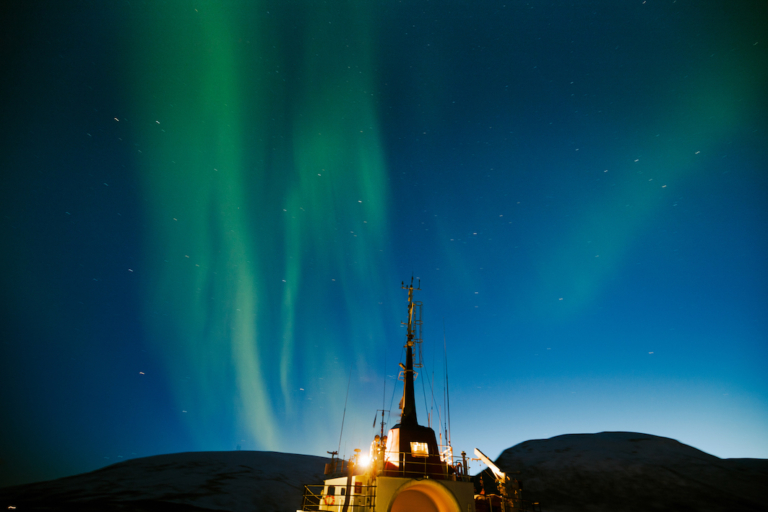
An extremely rare aurora has been observed in Spitsbergen
The phenomenon, never before observed from the Earth’s surface, is thought to be the result of a polar rain of electrons coming straight from the solar corona.
What is life like during the polar night?
People who live in Earth’s icy polar regions experience almost constant night every winter. This phenomenon is called the polar night, but what exactly is it? When does…

Where does the midnight sun come from?
The polar regions are known for the polar night, an almost unbroken winter night. In summer, on the other hand, the days grow longer and longer. The phenomenon…