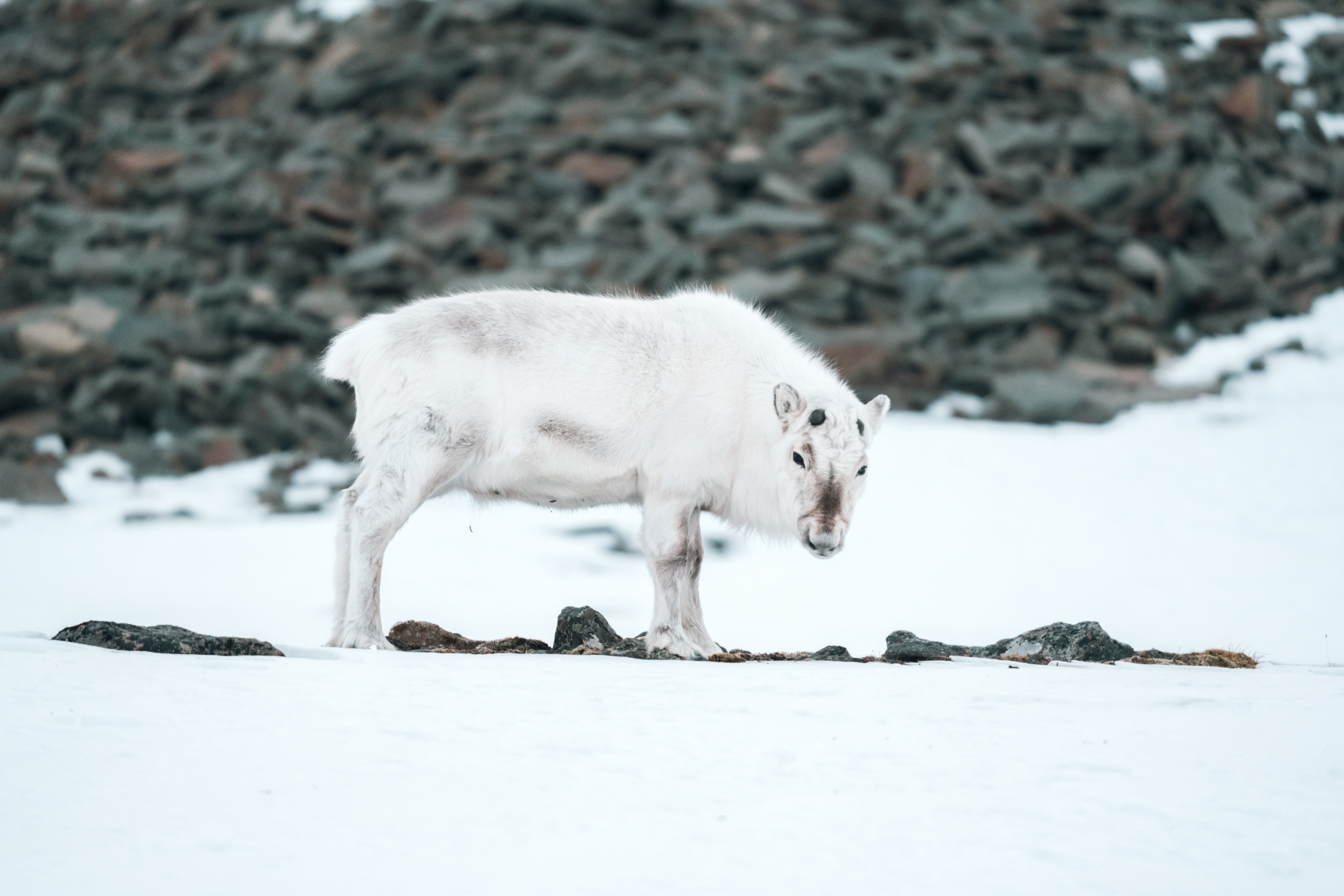
The Svalbard reindeer is the smallest of the nine reindeer subspecies
The Svalbard reindeer: a survivor perfectly adapted to the Arctic
Stocky, almost round on its short legs, the Svalbard reindeer does not look quite like the reindeer you see in Scandinavia or Lapland. Its unusual build is the result of several thousand years of evolution in one of the most extreme environments on the planet.
Endemic to the Svalbard archipelago, this subspecies lives nowhere else in the world. Seeing a Svalbard reindeer in its natural habitat is one of the most iconic encounters of a voyage to the heart of the Far North.
A resident of Svalbard for nearly 5,000 years
The Svalbard reindeer (Rangifer tarandus platyrhynchus) has lived in the archipelago for about 5,000 years. Its ancestors are thought to have reached these islands at the end of the last ice age, probably by crossing frozen expanses that then connected the European mainland to Svalbard.
Once isolated in the archipelago, this population evolved independently of its Eurasian cousins. Over the millennia, natural selection shaped an animal perfectly suited to the long polar nights, extreme temperatures and scarce food.
Today, the Svalbard reindeer is one of the few large land mammals that live year-round in this polar environment.
A body built to withstand the cold
At first glance, its build is surprising. Smaller than the other reindeer subspecies, it has a particularly compact body, a thick neck and short legs.
This stocky shape is no accident. By reducing the surface of the body exposed to the cold, it limits heat loss, a crucial advantage when temperatures drop well below –20°C in winter.
Its thick fur is another remarkable adaptation. Very dense, it traps a thick layer of air that acts as natural insulation. In summer, its coat is a light brown that blends into the tundra. As winter arrives, it turns much paler, almost white, providing excellent camouflage in the snowy landscape.
Its broad hooves also play a vital role. They let it walk on soft snow without sinking in too far, and double as real pickaxes for digging out the lichens and mosses buried under snow or ice.
Average eyesight… but an exceptional sense of smell
Contrary to what you might think, the Svalbard reindeer does not have very good eyesight.
To identify anything unusual, it relies instead on its keen sense of smell. When it spots a visitor, it is not unusual to see it approach cautiously, sometimes to within about twenty meters, staying downwind so it can analyze the scents before deciding whether to run away.
This behavior often intrigues travelers. The reindeer seems curious and not very shy, but above all it is trying to figure out what is in front of it.
This relative trust is also explained by the near absence of land predators in the archipelago. For thousands of years, the Svalbard reindeer evolved in an environment where it had virtually nothing to fear on dry land.
The birth of the calves, a special moment
Spring turns the Arctic tundra into a vast pantry. From June onward, as the vegetation grows at lightning speed under the midnight sun, the females give birth to a single calf.
Just a few hours after birth, the young is already able to follow its mother. This early independence is essential in a place where the growing season is extremely short.
For travelers, early summer is one of the best times to witness these heartwarming scenes. The young calves stay by their mother’s side at all times, gradually discovering their surroundings while learning to find food.
Antlers worn by males… and females
As with other reindeer, both sexes grow antlers, a rare trait among deer.
Males grow their antlers in spring and use them during the fall rut to compete with their rivals. They usually shed them at the start of winter.
Females, on the other hand, often keep their antlers until the following spring. Scientists believe this gives them an advantage in defending the best feeding spots during pregnancy, when food is scarce.
A species saved from extinction
Yet the Svalbard reindeer has not always lived in peace.
From the 17th century onward, European hunters in the archipelago hunted it heavily for its meat, hide and antlers. By the early 20th century, the subspecies was close to vanishing from many parts of Svalbard.
Faced with this dramatic decline, the Norwegian authorities banned hunting it in 1925. This protection allowed the populations to recover gradually.
Today, the archipelago is estimated to be home to about 20,000 Svalbard reindeer. Their distribution remains very fragmented, however. Glaciers, mountain ranges and vast fjords naturally limit movement between the different areas, so each population develops almost independently of the others.
A species already facing climate change
Although the Svalbard reindeer survived the ice ages and intensive hunting, it now faces a new threat: global warming.
Winters are increasingly marked by spells of rain followed by frost. A thick crust of ice then forms on the ground, trapping lichens and mosses beneath a layer that reindeer struggle to break with their hooves.
In some years, these conditions cause heavy losses, especially among the young and the weakest animals. Scientists are therefore keeping a close eye on the species, which is considered an excellent indicator of the effects of climate change in the Arctic.
A living symbol of Spitsbergen
Discreet, peaceful and perfectly adapted to its environment, the Svalbard reindeer embodies the resilience of Arctic wildlife.
Coming across one on a hike across the tundra or around the bend of a fjord is always a special moment. Behind its easygoing look lies a true survivor, shaped by thousands of years of evolution in one of the planet’s last great wildernesses.Sail to Spitsbergen
aboard Polarfront
Twelve guests, a seasoned crew and passionate guides: the upcoming departures.
10 days / 9 nights Spitsbergen · WildlifePolar spring in Spitsbergen 12 of 12 spots from€12,490 25Apr2027 returning May 4 Spring
10 days / 9 nights Spitsbergen · WildlifePolar spring in Spitsbergen 5 of 12 spots from€12,490 4Aug2027 returning Aug 13 Summer
10 days / 9 nights Spitsbergen · WildlifeMidnight sun in Svalbard 11 of 12 spots from€12,620 19Sep2027 returning Sep 26 Fall
8 days / 7 nights Spitsbergen · Northern lightsAutumn escape to Svalbard 12 of 12 spots from€9,720 26Sep2027 returning Oct 4 Fall
9 days / 8 nights Spitsbergen · Northern lightsAutumn lights in Svalbard 10 of 12 spots from€11,110 4Oct2027 returning Oct 12 Fall
9 days / 8 nights Spitsbergen · Northern lightsAutumn lights in Svalbard 12 of 12 spots from€11,110
No upcoming departures for this selection.
Polar bears in Spitsbergen: where and when to see them
Seeing a polar bear in the wild is the dream of many travelers heading to Spitsbergen. The archipelago is one of the best places in the world to…
10 sounds of the Arctic you will never forget
Traveling in the polar regions means learning to slow down and pay attention to details we often overlook in everyday life. In these places, where the absence of…
Arctic fox: how does it survive in one of the most hostile environments on the planet?
In the white vastness of the Arctic, a discreet silhouette sometimes crosses the snow-covered tundra. Fast, agile and perfectly camouflaged, the Arctic fox (Vulpes lagopus) is one of…