An extremely rare aurora has been observed in Spitsbergen
The phenomenon, never before observed from the Earth’s surface, is thought to be the result of a polar rain of electrons coming straight from the solar corona.
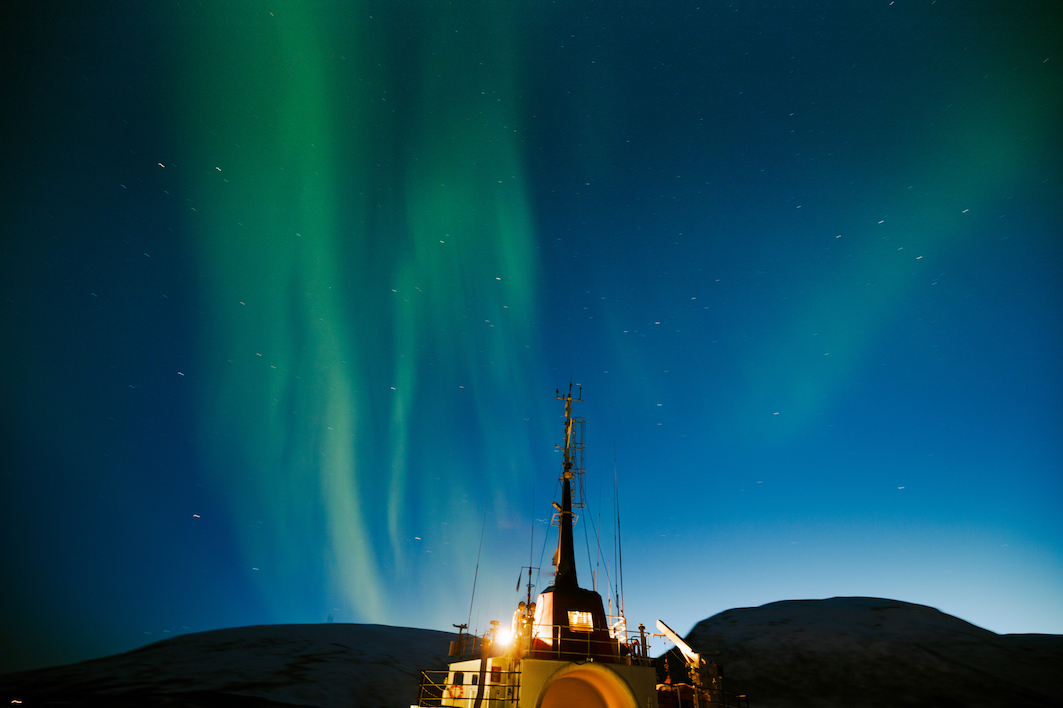
In the early hours of a Christmas morning in the Svalbard archipelago, in Norway, a fisheye lens was pointed at a night sky lit up in brilliant green. Unlike ordinary northern lights, which adorn the sky like thin, luminous veils winding beneath the stars, this aurora took the form of a vast, almost uniform blanket of green light.
This strange aurora covered the sky over the North Pole on December 25 and 26, 2022, and according to a paper published by Hosokawa and colleagues in Science Advances, this rare phenomenon is known as a “polar rain aurora”: an aurora produced by polar rain.
Electron rain over the North Pole
Auroras light up the night sky when electrons ejected by the Sun reach the Earth and become trapped, then accelerated, by its magnetic field. These electrons are emitted by the solar corona, the outermost layer of our star’s atmosphere, in the form of a plasma known as the solar wind.
Because of the wide variety of high-energy particles in the solar wind, the electrons it carries generally do not have enough energy, when they reach the Earth, to produce visible auroras. However, once trapped and energized by our planet’s magnetic field, these electrons begin to interact with the atoms in our atmosphere, and that is what produces auroras. These light shows appear around the poles, but rarely above the polar caps themselves.
Polar rain auroras, on the other hand, are produced directly by these electrons, in the rare cases when the solar wind is weak or even nonexistent.
This type of polar aurora had already been observed by satellites in the past, but never by cameras on the ground.
28 hours without solar wind
Besides being caused by the arrival of relatively weak electrons coming directly from our star, this exceptional phenomenon also occurred in the middle of a 28-hour period during which almost no solar wind was recorded, apart from the polar rain of electrons, which is particularly rare.
Our star’s corona constantly emits streams of solar wind, which is why it is so unusual to see them almost disappear. This is something we witness only once every twenty years or so: the only other observation of such a polar aurora, which at the time had been seen only from space, dates back to 2004.
Because there was no solar wind, the aurora studied by Hosokawa was exceptionally bright, and therefore easier to observe from the Earth’s surface. Observing this aurora both from the ground and from space is essential if specialists are to understand both the fine details and the large-scale patterns that made it up.
What’s more, since the electrons behind these “polar rain auroras” come straight from the Sun, they act as a shadow, or an imprint, of the environment they come from. Hosokawa and his colleagues hope to use the data they collected to understand the relationship between the electrons that reach the Earth and their place of origin in the Sun’s atmosphere.
Source: National Geographic, Isabel Swafford, article published June 26, 2024
Sail to Spitsbergen
aboard Polarfront
Twelve guests, a seasoned crew and passionate guides: the upcoming departures.
10 days / 9 nights Spitsbergen · WildlifePolar spring in Spitsbergen 12 of 12 spots from€12,490 25Apr2027 returning May 4 Spring
10 days / 9 nights Spitsbergen · WildlifePolar spring in Spitsbergen 5 of 12 spots from€12,490 4Aug2027 returning Aug 13 Summer
10 days / 9 nights Spitsbergen · WildlifeMidnight sun in Svalbard 11 of 12 spots from€12,620 19Sep2027 returning Sep 26 Fall
8 days / 7 nights Spitsbergen · Northern lightsAutumn escape to Svalbard 12 of 12 spots from€9,720 26Sep2027 returning Oct 4 Fall
9 days / 8 nights Spitsbergen · Northern lightsAutumn lights in Svalbard 10 of 12 spots from€11,110 4Oct2027 returning Oct 12 Fall
9 days / 8 nights Spitsbergen · Northern lightsAutumn lights in Svalbard 12 of 12 spots from€11,110
No upcoming departures for this selection.
What is life like during the polar night?
People who live in Earth’s icy polar regions experience almost constant night every winter. This phenomenon is called the polar night, but what exactly is it? When does…

Where does the midnight sun come from?
The polar regions are known for the polar night, an almost unbroken winter night. In summer, on the other hand, the days grow longer and longer. The phenomenon…
Why do the northern lights come in different colors?
Brilliant green, deep red, purple, pink or even blue… Polar auroras can put on a true light show. Green is by far the most common color, but it…