In Greenland, narwhals reveal the secrets of the deep
On Greenland’s east coast, the fjords hide an essential part of their story beneath the surface. To explore these hard-to-reach depths, researchers enlisted some remarkable companions: six narwhals fitted with sensors. Their movements have shed new light on how Atlantic waters make their way into the basins close to the glaciers.
Six narwhals in the service of science
How do you study the ocean where ice and sailing conditions keep research vessels at bay? In the Scoresby Sund region, a team of researchers used the dives of narwhals to gather valuable data.
Six animals, caught and tagged with the help of local hunters, carried sensors measuring temperature, salinity and depth. Between 2017 and 2020, they collected 2,060 oceanographic profiles, some more than 1,500 meters below the surface. As they went about their natural movements, these marine mammals explored areas where measurements had until then been scarce. An exceptional opportunity to observe the fjords at their most inaccessible.Beneath the polar waters, the influence of the Atlantic
Published in August 2026 in Science Advances, the study led by Mads Peter Heide-Jørgensen and his colleagues documents the presence of relatively warm, salty Atlantic water at the heart of East Greenland’s fjords.
This water flows at depth, beneath the colder polar water. The measurements show it reaching basins up to 300 kilometers inland, in front of some of the glaciers. This phenomenon, known as “Atlantification,” reflects the growing influence of the Atlantic in this Arctic environment. To track how it is changing, the researchers compared the data gathered by the narwhals with more than 2,200 historical profiles. Their analyses show the Atlantic layer thickening, while the upper layer of polar water is thinning.Understanding glaciers from the depths
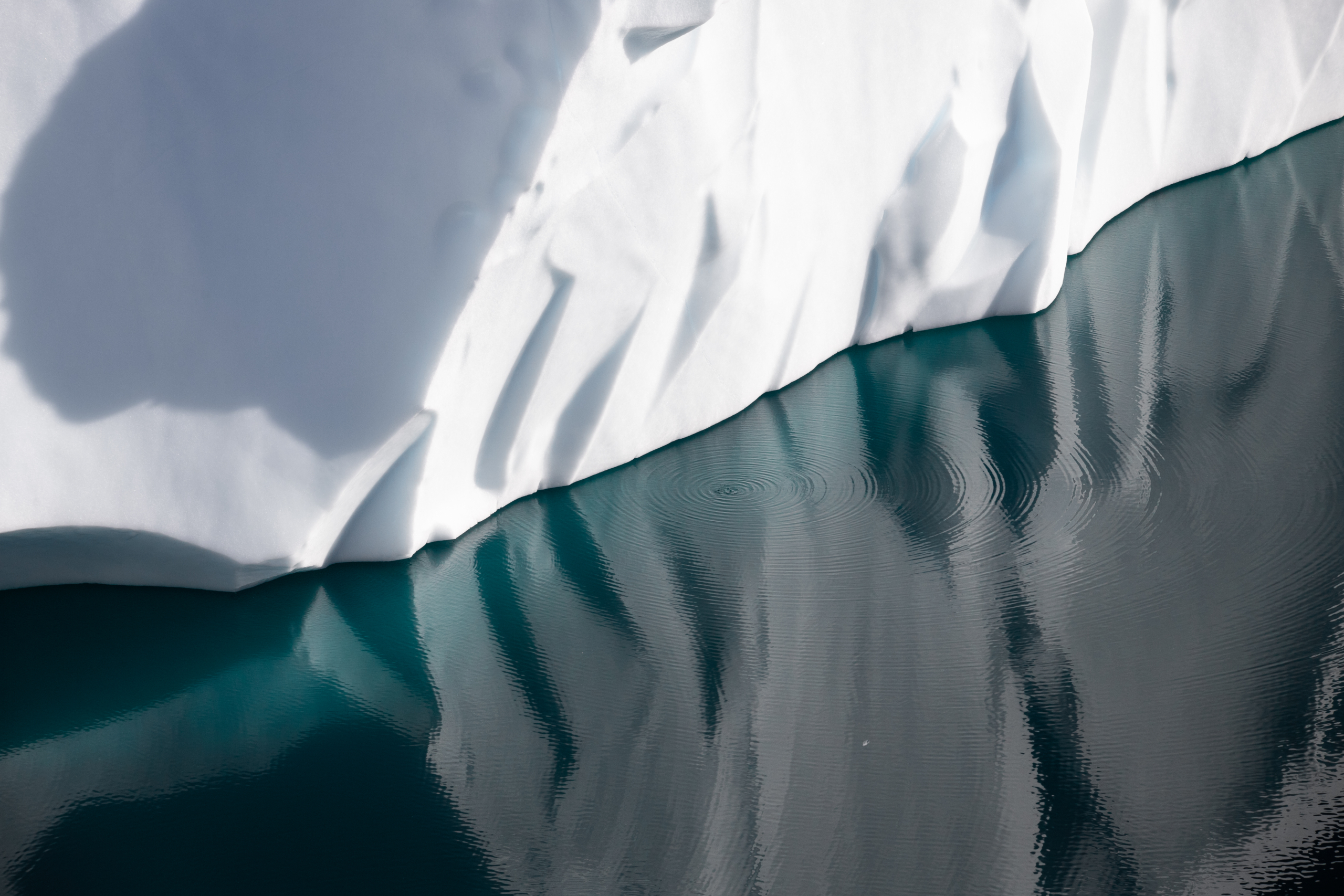
Facing a glacier, your eye is naturally drawn to the ice towering over the sea. Yet part of the exchange takes place beneath the surface, where the ocean meets the glacier’s submerged face.
By reaching the deep basins in front of the glaciers, Atlantic water can speed up their underwater melting. The data collected help to describe these contacts between ocean and ice more precisely, and to improve the melt estimates used in climate models. This work also sheds light on how the narwhals’ environment may change. Atlantification could alter the distribution of certain species and the food web. The study does not, however, measure any change in narwhal numbers: its main finding concerns the waters they swim through.Seeing Scoresby Sund in a new light
These discoveries add a new dimension to exploring East Greenland. Behind the landscapes you admire from the deck of Polarfront lies a world of currents, undersea relief and exchanges between water and ice.
Sailing through Scoresby Sund is also about taking the time to understand what shapes these landscapes. A glacier becomes the meeting point between mountain and ocean. A fjord reveals unseen currents. And the narwhal, even when it slips out of sight, helps us know this world a little better.On your next expedition aboard Polarfront, let your gaze follow the glaciers down to the sea… then picture the depths the narwhals have helped scientists explore.
Further reading: the study in Science Advances, NAMMCO summary of October 6, 2026.DREAMING OF SEEING A NARWHAL?
Sail to Greenland
aboard Polarfront
Twelve guests, a seasoned crew and passionate guides: the upcoming departures.
11 days / 10 nights Greenland · Northern lightsNortheast Greenland National Park Last spot from€13,880 9Sep2027 returning Sep 19 Fall
11 days / 10 nights Greenland · Northern lightsFrom East Greenland to Spitsbergen 12 of 12 spots from€13,880
No upcoming departures for this selection.
Polar bears in Spitsbergen: where and when to see them
Seeing a polar bear in the wild is the dream of many travelers heading to Spitsbergen. The archipelago is one of the best places in the world to…
10 sounds of the Arctic you will never forget
Traveling in the polar regions means learning to slow down and pay attention to details we often overlook in everyday life. In these places, where the absence of…
Arctic fox: how does it survive in one of the most hostile environments on the planet?
In the white vastness of the Arctic, a discreet silhouette sometimes crosses the snow-covered tundra. Fast, agile and perfectly camouflaged, the Arctic fox (Vulpes lagopus) is one of…