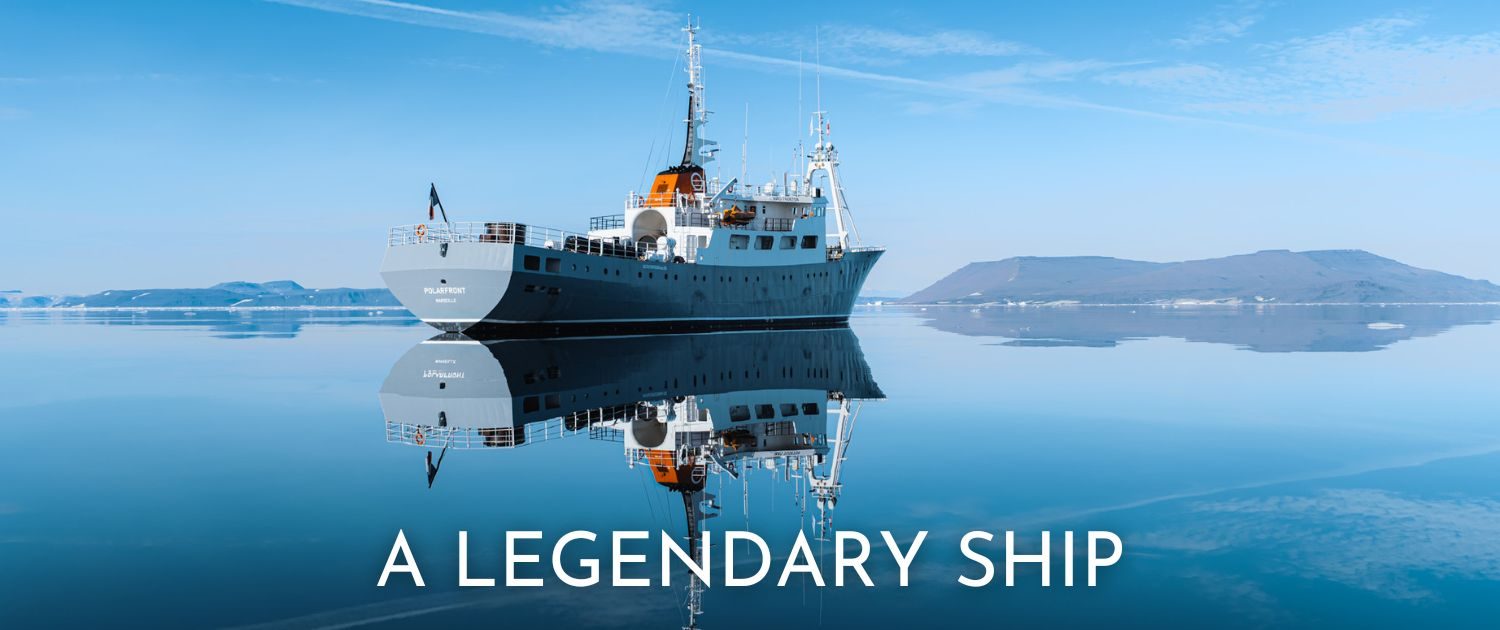

Polarfront anchored in front of penguins in Spitsbergen (photo taken by Mathéo Ganadu, steward on board Polarfront, in July 2021)
POLARFRONT – THE WORLD’S LAST WEATHER SHIP
Built in Norway and chartered by the Norwegian Meteorological Institute for almost its entire service life, Polarfront is a veteran of the Far North, designed to withstand the harshest seas. It holds a special place in the world of scientific maritime operations, as it was the last weather ship to supply data to global databases.
Polarfront takes its name from the Polar Front theory, developed in the early 20th century by Norwegian meteorologists. The polar front is an extreme boundary, a kind of interface separating polar air on one side from tropical air on the other. This theory helps explain weather phenomena in the temperate latitudes.
Positioned at 66°N 2°E, around 450 kilometers off the coast of Norway, Polarfront was assigned to Station M (Mike), the roughest of a network of 13 weather stations in the North Atlantic.
Over more than 60 years of observations, Station M collected temperature and salinity measurements five times a week down to depths of 2,500 meters. It also provided key data on the long-term variability of the Nordic Seas and on changes in circulation patterns in the Atlantic Ocean.
Polarfront also distinguished herself by carrying out, for 10 years, measurements tracking changes in CO₂ levels on behalf of the National Oceanic and Atmospheric Administration (U.S. Department of Commerce), at the convergence of polar and tropical air masses.
Weather ships have now been replaced by scientific buoys and meteorological satellites.